



The Eyes Above the Road
Flock Safety, Hacking Risks, Police Abuse and the Infrastructure of Mass Surveillance
By Ashton Seales
A camera appears beside a roadway.
It may be mounted on a black pole, attached to a traffic sign or powered by a small solar panel. It does not issue speeding tickets. It does not simply record an intersection in case something happens.
It photographs passing vehicles, attempts to read their license plates and uses artificial intelligence to catalog details such as vehicle color, make, model, body type, damage, temporary tags and other distinguishing features. Each observation is associated with a time and location and uploaded into a searchable cloud platform.
One camera may only document a single road.
Thousands of connected cameras can reconstruct a person’s movements across a city.
Tens of thousands, shared across jurisdictions, can create something much larger: a privately operated surveillance network capable of following vehicles across counties, cities and state lines.
Flock Safety markets that network as a public-safety tool. Its products can undoubtedly produce useful evidence during legitimate criminal investigations. But that narrow benefit cannot be allowed to obscure the system being constructed around it - an increasingly centralized collection of cameras, artificial intelligence, police databases, private surveillance feeds, drones, microphones and cloud infrastructure.
The question is no longer whether one license-plate camera can help solve a crime.
The question is whether Americans are willing to build a nationwide movement-tracking system first and establish meaningful constitutional safeguards afterward.
Flock Is Not Just One Kind of Camera
Public discussions about Flock often treat every device as though it were the same. They are not.
Flock now sells or operates a connected collection of license-plate readers, conventional video cameras, gunshot-detection sensors, mobile surveillance trailers, investigative software and drones. The company describes its platform as connecting “detection, investigation, and response” through license-plate recognition, video, audio detection and real-time coordination.
License-plate readers
Flock’s best-known products are automated license-plate readers, commonly called ALPRs or LPRs.
These cameras capture images of passing vehicles and extract searchable information from them. Unlike a red-light or speeding camera, an ALPR is not primarily designed to document a traffic violation. Its purpose is to identify, catalog and later locate vehicles.
The system can search more than a plate number. Flock advertises vehicle identification based on details including make, color and distinguishing characteristics. The ACLU says the system can catalog bumper stickers, scratches and other features, turning ordinary vehicle images into a searchable movement database.
These devices generally should not be described as continuously livestreaming video. They capture vehicle images and associated metadata, temporarily process or store the material on the device and then upload it through a cellular or network connection to Flock’s cloud environment. Flock materials state that its law-enforcement data is stored using Amazon Web Services, including AWS GovCloud for criminal-justice information.
That distinction matters for accuracy, but it does not eliminate the privacy concern. A searchable record that says a particular vehicle was at a specific location at a specific time can reveal far more about a person’s life than an ordinary traffic camera that nobody examines unless an incident occurs.
Live and recorded video cameras
Flock also markets fixed and pan-tilt-zoom video cameras. These are more like traditional surveillance cameras and can provide live and recorded video, digital zoom, remote camera controls and cloud-based access.
The company advertises AI alerts for people and vehicles and tools capable of searching recorded footage without manually watching hours of video. These systems are intended for continuous security coverage at locations such as streets, buildings, parks, intersections and parking areas.
These video products make the statement that Flock cameras “do not track people” increasingly difficult to apply across the company’s entire ecosystem. A license-plate reader may focus on vehicles, but Flock’s video systems specifically advertise people-detection alerts.
Audio detection
Flock also operates audio-detection technology intended to recognize sounds associated with emergencies, particularly gunfire. Such systems turn microphones positioned in public areas into automated alerting sensors.
Audio detection raises a separate set of questions: what the microphone can hear, what is processed locally, what is transmitted, how non-gunshot sounds are handled and whether future software updates could expand the system’s purpose.
A physical microphone may remain the same while its capabilities change through software.
Drones and mobile surveillance
Flock’s Drone as First Responder system is designed to launch remotely and send live aerial video to emergency personnel before officers arrive. Its mobile security trailers combine elevated cameras, remote monitoring and rapid deployment.
Drones may be justified during a missing-person search, active threat or disaster. But a drone integrated into a real-time policing platform can also be used for routine observation, protest monitoring or following individuals.
The technology itself does not enforce the boundary. Policy, law and meaningful external oversight do.
FlockOS and the investigative platform
The most consequential product may not be a camera at all.
FlockOS is the software layer that combines sensor data, searches, alerts and evidence across departments and locations. Flock promotes cross-agency visibility and the ability to connect incidents that cross jurisdictional boundaries.
That is the central issue.
A camera watches one location. A platform connects locations.
Once a vehicle appears repeatedly across a network, the system can help establish where it traveled, when it appeared and which jurisdictions observed it. The cameras become collection points for a centralized investigative tool operated not by the public, but by a private corporation.
A Private Company Between the Public and the Police
Flock is not a democratically accountable public agency.
It is a private surveillance vendor selling access to public agencies, businesses, schools, homeowners’ associations and other customers. Local governments may pay for the cameras, but the images, searches, software, security architecture and interagency connections run through Flock’s platform.
This arrangement creates an unusual transfer of public power.
Police traditionally needed their own personnel and resources to follow someone from one location to another. Large-scale physical surveillance was expensive, visible and difficult to sustain.
An interconnected ALPR system radically reduces that cost.
An officer can search historical records, establish where a vehicle appeared and request access from other participating agencies without physically maintaining surveillance on every road. Flock explicitly promotes the ability to locate vehicles and collaborate across jurisdictions.
The ACLU estimates that tens of thousands of Flock cameras have been installed in urban and rural areas and warns that the network uploads vehicle observations into a database searchable by participating law-enforcement agencies, often with inadequate oversight. It also reports that fewer than 1 percent of vehicles scanned are associated with suspected wrongdoing.
That means the overwhelming majority of the system’s subjects are not suspects.
They are ordinary people driving to work, visiting family, attending religious services, meeting a journalist, going to a political event, seeking medical care or entering the office of an attorney.
A license plate does not reveal a person’s thoughts.
A sufficiently detailed history of where that plate appears may reveal nearly everything else.
Researchers Found More Than a Theoretical Risk
Privacy concerns might be dismissed as speculative were it not for what independent researchers have demonstrated.
Cybersecurity researcher Jon Gaines, known as GainSec, documented dozens of reported security issues affecting the Flock ecosystem. In November 2025, Gaines said his formal research summary covered 45 issues, 44 of which he discovered, reported and disclosed himself.
His work was brought to a wider audience by musician, science communicator and investigative YouTuber Benn Jordan, working with Gaines and cybersecurity researcher Joshua Michael.
In Jordan’s video, “We Hacked Flock Safety Cameras in Under 30 Seconds,” the researchers demonstrated that physical access to a legally obtained Flock device could expose administrative functions and allow deep control over the Android-based system. The demonstration showed how an attacker with access to the unit could potentially transform surveillance hardware into an unauthorized camera, network foothold or malware host.
Jordan later documented publicly exposed Flock video feeds, including a camera reportedly aimed toward a playground and broadcasting online without proper access restrictions.
These were not merely social-media allegations. Multiple vulnerabilities affecting Flock components were subsequently recorded through the formal Common Vulnerabilities and Exposures process and published by the National Vulnerability Database.
Among them:
CVE-2025-47822 documented improper access control on an on-chip debug interface affecting Flock LPR firmware, with potential consequences for confidentiality, integrity and availability.
CVE-2025-59403 documented a lack of authentication on administrative endpoints in an Android application responsible for camera feeds on Falcon, Sparrow and Bravo devices. Those endpoints reportedly included functions for rebooting the device, collecting logs and enabling Android debugging.
CVE-2025-59405 documented a cleartext monitoring-service API credential embedded in software installed on Falcon and Sparrow readers and Bravo edge-computing devices.
CVE-2025-59406 documented another cleartext authentication secret embedded in a Flock application.
CVE-2025-59407 documented a bundled Java keystore, its hardcoded password and a private key within software installed on multiple Flock device types.
A vulnerability does not automatically prove that every deployed Flock camera was compromised. Some findings required physical access, particular software versions or specific conditions.
But physical-access requirements should not be casually dismissed when the devices are installed outdoors, sometimes on publicly accessible roadside poles. More importantly, the findings challenge any claim that these systems should be trusted simply because the company says they are secure.
A public agency considering a surveillance network should not ask whether the vendor promises cybersecurity.
It should demand independent evidence.
The Warning Reached City Hall
Jordan did not limit his concerns to YouTube.
He appeared before the Dunwoody, Georgia, City Council during its consideration of additional Flock services. Public concern, records obtained by local advocates and questions about security contributed to multiple delays in the proposed agreement.
Reporting on the meetings described concerns over data sharing, unauthorized access and whether private-camera information marked not to be shared had nevertheless become accessible to outside departments. A Flock employee’s access to a camera associated with the Marcus Jewish Community Center also concerned city leaders.
Jordan’s central recommendation was straightforward: cities should require an independent security audit before trusting a surveillance vendor.
That should not be considered a radical demand.
Cities routinely require engineering inspections before opening a bridge. They audit financial statements before issuing bonds. They require insurance, licensing and inspections from contractors performing physical work.
Yet local governments are being asked to install systems capable of reconstructing people’s movements while relying heavily on assurances supplied by the same vendor seeking the contract.
A police chief is not necessarily a cybersecurity expert.
A council member is not necessarily an artificial-intelligence auditor.
A sales presentation is not an independent assessment.
When Surveillance Access Becomes Personal
The danger is not limited to outside hackers.
A secure surveillance system can still be abused by an authorized user.
The Institute for Justice reported in April 2026 that police officers had used license-plate-reader systems to monitor romantic interests at least 14 times in recent years. The reported subjects included spouses, former partners and strangers who attracted an officer’s personal attention.
These incidents expose the weakness of a familiar defense: “Every search is logged.”
Logs can help establish what happened after misconduct is discovered. They do not necessarily prevent an officer from carrying out an improper search in the first place.
Accountability also depends on someone regularly examining the logs, recognizing suspicious behavior, investigating it and imposing consequences. The ACLU has warned that agencies and vendors frequently point to audit logs as a safeguard even when auditing is incomplete, inconsistent or reactive.
The ACLU’s current campaign against unregulated ALPR systems cites several other alarming examples:
Kansas police reportedly used license-plate-reader information in connection with a man who had written an opinion piece critical of the department.
A Colorado officer allegedly relied on a faulty Flock result to accuse a woman of theft and disregarded evidence indicating the system was wrong.
In another widely reported incident involving ALPR technology, a mother and her children were detained at gunpoint after their vehicle was wrongly identified as stolen.
Flock readers have also produced concerns involving immigration enforcement. Investigations found that local searches and interagency-sharing configurations allowed Flock information to be used in ways that communities and even some participating agencies did not fully understand. Flock later halted one federal pilot program after public controversy over how the network was being used.
A surveillance system can be abused for political monitoring, immigration enforcement, domestic stalking or retaliation against critics without changing a single line of code.
The same search box used to locate a stolen vehicle can be used to locate an ex-partner.
The difference is not technological.
It is the intention of the person typing the query; and whether anyone is watching them.
Artificial Intelligence Expands the Search
Flock and supportive officials frequently emphasize that its license-plate readers do not use facial recognition.
That is relevant, but incomplete.
A system does not need to identify a human face to track a person’s movements.
Most Americans travel in vehicles registered to themselves, relatives or employers. Identifying the vehicle, searching its distinctive characteristics and documenting it repeatedly can function as a practical proxy for tracking the person associated with it.
Flock has also developed AI-based tools that move beyond exact plate matching. The ACLU reported that Flock introduced functionality designed to identify driving patterns the software considers suspicious.
That changes the role of the system.
It is no longer only responding when officers enter a known plate associated with a specific crime. The algorithm itself can help decide which patterns deserve police attention.
Artificial intelligence does not eliminate human bias. It can automate assumptions and apply them across enormous datasets at a speed no human investigator could match.
A driver circling a block may be planning a burglary.
The driver may also be lost, delivering food, looking for an address, avoiding road construction or trying to calm a crying child.
Once an algorithm labels ordinary behavior as suspicious, police attention may follow before the person has done anything illegal.
The National Network Is the Product
Flock often stresses local ownership and local control.
But the value of its system grows because cameras and agencies are connected.
A single town’s database may show that a vehicle entered town.
A multi-state network may show where it came from, where it stopped, which route it took and where it went next.
Flock itself promotes cross-agency visibility as a central advantage.
That network effect means a local council is not merely voting on a few cameras.
It is deciding whether to attach the community to a much larger surveillance system.
Officials may believe their written policy prohibits certain searches. But the network’s practical reach also depends on software settings, mutual-sharing agreements, user permissions, federal requests, neighboring agencies, vendor employees and future contract language.
In Dunwoody, records reportedly showed that private camera data marked “do not share” had nevertheless been accessible to four other departments until the issue was corrected.
A safeguard that exists only as a checkbox can be removed by another checkbox.
Flock’s Own Claims Require Scrutiny
Flock says searches are logged, customers control their data, information is encrypted and privacy protections are built into the platform. It also says its products support enormous numbers of investigations and public-safety outcomes.
Those claims deserve to be presented.
They also deserve verification.
In July 2026, the ACLU published a detailed criticism accusing Flock of making misleading or false statements to local governments and the public about system capabilities and data practices. Among the disputes was whether Flock’s software could create maps revealing a vehicle’s movement history.
Meanwhile, cities have begun canceling, pausing or reconsidering Flock agreements amid concerns over transparency, immigration access, cybersecurity and police misuse. More than 80 municipalities had reportedly ended contracts by July 2026.
Douglas County, Colorado, decided to leave Flock after officials learned that a camera at a public open-space property had been accessible online. The sheriff said the incident damaged his trust in the company.
In Troy, New York, the dispute became so severe that the mayor declared a state of emergency to continue paying for the system after the council sought to stop payments. Residents objected that cameras had been installed without adequate public approval, while council members sought stronger limits on retention and use.
When surveillance becomes powerful enough that officials declare an emergency to preserve it, the public should pay attention.
The Data-Center Connection
Flock’s roadside cameras are only the visible edge of the system.
The actual power exists elsewhere; in servers, cloud platforms and data centers capable of storing, organizing, searching and sharing enormous quantities of information.
A license-plate image becomes useful for long-term surveillance only after it is uploaded, indexed and connected to other observations.
An AI camera becomes scalable only when computing infrastructure can analyze footage and compare patterns across time.
A drone becomes part of a coordinated surveillance system when its live video can be routed into the same software environment used by dispatchers, analysts and officers.
Flock states that cloud infrastructure, including Amazon Web Services, is used to store and protect its information.
This is where the debate over surveillance and the debate over data centers converge.
Communities are being asked to approve enormous data-center projects based on promises of jobs, tax revenue and technological progress. At the same time, police departments and private companies are deploying systems that generate growing quantities of images, video, audio, location records and AI-derived intelligence.
The cameras collect.
The data centers remember.
Without the server infrastructure, a camera is an isolated device with limited storage.
With cloud computing, artificial intelligence and interagency access, it becomes one node in a national surveillance architecture.
Data centers also impose physical costs on communities. The International Energy Agency projects that global data-center electricity consumption could approximately double by 2030, reaching around 945 terawatt-hours annually.
The public therefore bears risks on both ends.
Residents may face the environmental and infrastructure pressures associated with rapidly expanding data centers (electricity demand, grid construction, land use and sometimes substantial cooling requirements) while those same facilities support private systems that collect and analyze the public’s movements.
A community should not debate data-center construction solely in terms of megawatts and tax abatements.
It should ask what data will be processed there.
Who will own it?
Which surveillance and AI companies will use the capacity?
Will public agencies purchase services running through the facility?
What information will be retained, combined or sold?
Will the center support systems used for immigration enforcement, protest monitoring, predictive policing or mass location tracking?
The physical infrastructure and the surveillance applications cannot be treated as unrelated issues.
One supplies the eyes.
The other supplies the memory and analytical power.
The Absence of Regulation Is a Policy Choice
The United States does not need to ban every license-plate reader, video camera or police drone to protect civil liberties.
There are legitimate uses for narrowly targeted technology.
A camera alert based on a plate connected to an active Amber Alert is fundamentally different from allowing thousands of officers to search years of ordinary travel without a warrant.
A drone deployed to locate a missing child is fundamentally different from routine aerial patrol over lawful demonstrations.
The problem is that many communities adopted these systems without first establishing enforceable boundaries.
At minimum, any government using Flock or a comparable system should require:
A warrant for historical movement searches, with tightly defined emergency exceptions.
A prohibition against searching people engaged in lawful political, religious, journalistic or protest activity.
A prohibition against personal, romantic, retaliatory or immigration-related searches that are not authorized by law and local policy.
Extremely short default retention periods unless specific data is preserved for a documented investigation.
No automatic nationwide or statewide data sharing.
Public disclosure of every participating agency and outside organization with access.
Independent cybersecurity testing conducted by experts chosen by the government - not the vendor.
Annual public audits of searches, sharing, false alerts, disciplinary incidents and policy violations.
Automatic alerts for suspicious searches involving employees, elected officials, journalists, romantic partners or repeated queries without a case number.
Meaningful criminal and employment penalties for intentional misuse.
Public votes before cameras, drones, microphones or AI analytics are added or expanded.
Clear contractual language preventing Flock from unilaterally expanding data use through revised terms of service.
The right of residents to learn whether their vehicle was improperly searched after an investigation concludes.
Independent environmental, infrastructure and civil-liberties reviews before public incentives are granted to data centers supporting surveillance or AI operations.
A system that cannot operate under those requirements may not be safe enough for government use.
We Should Not Have to Trust Everyone Forever
Supporters frequently argue that critics should trust local police.
That misses the point.
Constitutional protections are not accusations against every current officer. They exist because no institution should receive unlimited power based on an assumption that everyone who holds that power - today and decades from now - will always use it properly.
The officials approving these cameras will eventually leave office.
Police leadership will change.
Corporate ownership may change.
Contract terms will change.
Software capabilities will change.
Artificial intelligence will improve.
Political conditions will change.
Data gathered for one purpose can be repurposed for another.
A community may trust its current police chief not to monitor political opponents. It cannot guarantee that every future chief, officer, federal partner, vendor employee or hacker will show the same restraint.
We do not lock the courthouse because we believe every resident is a thief.
We lock it because valuable things require protection.
A record of an entire population’s movements is extraordinarily valuable.
It deserves more protection than a promise made during a sales presentation.
The Surveillance State Will Arrive Quietly
An authoritarian surveillance state rarely announces itself with a single dramatic law.
It arrives one camera at a time.
One police contract at a time.
One emergency exception at a time.
One database-sharing agreement at a time.
One promise that the technology is only being used against criminals.
Countries such as Russia have demonstrated how interconnected cameras, facial recognition, telecommunications records and centralized government power can be used to identify demonstrators, monitor political activity and suppress dissent.
The United States is not Russia.
But that does not mean it is immune from constructing similar technical capabilities.
The defining question is not whether today’s officials intend to create an authoritarian system.
It is whether they are assembling infrastructure that a future government could use as one.
Once cameras blanket the roads, drones patrol from above, microphones listen for classified sounds, private platforms combine the evidence and data centers preserve the results, meaningful anonymity in public becomes nearly impossible.
At that point, regulation will be more difficult because agencies will claim they cannot function without the system.
That is why rules must come first.
Before expansion.
Before permanent dependency.
Before the next vulnerability.
Before the next officer searches for an ex-partner.
Before the next journalist, protester, immigrant, political opponent or ordinary resident discovers that a machine has quietly documented every place they went.
Public safety matters.
So does the public’s freedom from constant suspicion.
We should demand independent audits, strict warrant requirements, short retention periods, transparent data-center agreements and enforceable limits on every surveillance system operating in our communities.
Because a free society should not require innocent people to prove they have nothing to hide.
It should require the government (and every private company operating on its behalf) to prove why it has the right to watch.

Small Towns Are Not Immune
Two Fatal ICE Shootings Carry a Warning for Marion
By Ashton Seales
Within a single week, two men were shot and killed by U.S. Immigration and Customs Enforcement officers during vehicle stops; one in Houston, Texas, and another in Biddeford, Maine.
The circumstances are still being investigated, and important details remain disputed. But several established facts should concern every American, regardless of their position on immigration policy.
Both men were driving vehicles that ICE officers were attempting to stop.
Both vehicles were moving when officers opened fire.
Neither man appears to have been the original target of the enforcement operation that placed ICE officers in his path.
And in both cases, the officers responsible for taking a human life were operating without body cameras recording what happened.
These were not carefully documented confrontations in which the public can independently examine the evidence. They were fatal uses of government force surrounded by incomplete video, conflicting accounts and statements issued by the same federal agency whose officers fired the shots.
That is not meaningful transparency.
It is a system that asks the public to accept the government’s version of events without providing the most basic evidence that could confirm (or contradict) it.
Maine: Johan Sebastián Durán Guerrero
On July 13, 2026, ICE officers conducting an enforcement operation in Biddeford, Maine, attempted to stop a vehicle driven by Johan Sebastián Durán Guerrero, a Colombian man living and working in the community.
Durán Guerrero was not the person ICE officers had originally gone there to arrest.
DHS initially said officers were surveilling a residence connected to someone with a final removal order. According to the agency, Durán Guerrero drove away from that residence, attempted to flee and created what an officer considered a threat to public safety.
An ICE officer then fired into the moving vehicle, fatally striking him.
Federal officials subsequently suggested the vehicle had been or was about to be used as a weapon. But available security footage does not show the actual moment the shots were fired, and reporting has left significant gaps in the official timeline. What the footage does show is Durán Guerrero’s vehicle continuing to move before officers removed him from it after the shooting.
The officers involved were not wearing body cameras. The most direct potential record of what the officer saw, where the officer was standing, how quickly the vehicle was moving and whether deadly force was truly unavoidable therefore does not exist.
The Maine Attorney General’s Office, the FBI and the Department of Homeland Security’s Office of Inspector General are now involved in investigations.
Those investigations must determine whether the officer’s stated fear was objectively reasonable, whether safer tactics were available and why ICE officers once again created a deadly confrontation around a moving vehicle.
But investigators will have to reconstruct those answers without body-camera footage from the officers themselves.
Texas: Lorenzo Salgado Araujo
Less than one week earlier, on July 7, 2026, ICE officers conducted a traffic stop in Houston involving Lorenzo Salgado Araujo. DHS has said Salgado Araujo attempted to flee in his van and tried to strike an officer, causing the officer to fear for his safety. The officer fired into the vehicle, killing him.
Attorneys representing witnesses who were inside the van have disputed the government’s account. They have said the officer was not in the vehicle’s path and that Salgado Araujo was shot through a passenger-side window as the van moved away. Those claims have not yet been fully tested through an independent investigation, but they demonstrate why objective footage is so important.
The ICE officers involved were not wearing body cameras.
DHS reportedly attributed that absence to delays in distributing the equipment. Whatever the administrative explanation, the result is the same: a federal officer killed a man during a disputed vehicle encounter, and the public has no body-camera recording through which to evaluate the agency’s account.
Texas Governor Greg Abbott has since confirmed that the Texas Rangers will investigate the shooting. That announcement came after days of calls from residents, elected officials and civil-rights advocates demanding an investigation independent of the federal agencies involved.
That investigation is necessary.
The agency whose employee fired the fatal shots should not be the only institution controlling the evidence, shaping the initial narrative and determining whether its own conduct was justified.
Firing Into Moving Vehicles Is Reckless
ICE has described both shootings as responses to vehicles that endangered officers or the public.
That claim deserves investigation, not automatic acceptance.
Law-enforcement agencies have long recognized that firing into moving vehicles is extraordinarily dangerous. Bullets can strike passengers or bystanders. A wounded or killed driver can lose control, turning the vehicle into a greater hazard. Officers may also place themselves directly in a vehicle’s path and then use the danger created by that positioning to justify deadly force.
The safer principle is straightforward: whenever reasonably possible, officers should move out of the vehicle’s path rather than fire into it.
Yet these two deaths followed a disturbingly similar pattern: ICE officers attempted vehicle stops, drivers moved away, officers claimed to fear the vehicles and officers opened fire without body cameras documenting the critical moments.
The shootings have now prompted federal officials to reconsider or suspend many ICE vehicle stops, an implicit acknowledgment that these tactics carry serious and foreseeable risks.
These were not unpredictable accidents. They were foreseeable outcomes of initiating high-pressure immigration encounters around occupied vehicles and placing armed officers in positions where the movement of those vehicles could quickly become the justification for gunfire.
When officers repeatedly create the same dangerous circumstances and people repeatedly die, the public must ask whether the problem is more than the individual decisions of one officer.
It may be the enforcement strategy itself.
No Cameras, but Immediate Government Narratives
In both cases, DHS quickly released statements portraying the drivers as threats. But the government did not provide body-camera recordings to substantiate those accounts because the officers were not wearing them.
That imbalance matters.
The government’s version is released immediately and repeated in headlines across the country. The person who was killed cannot respond. Families and witnesses must then fight for days or weeks simply to establish that another version of events exists.
Body cameras do not solve every accountability problem. They can be positioned poorly, activated late or withheld from the public. But their complete absence during planned federal enforcement operations is indefensible. ICE is not an obscure agency with limited resources. It is a heavily funded federal law-enforcement organization conducting armed operations in neighborhoods throughout the United States.
Agents entrusted with the authority to detain people, stop vehicles and use deadly force should be required to record their encounters.
A government powerful enough to conduct nationwide immigration raids is powerful enough to equip its officers with functioning cameras.
Biddeford Is Smaller Than Marion
Perhaps the most important lesson for Marion is where the Maine shooting occurred.
Biddeford is not New York City, Chicago, Los Angeles or Houston.
It is a small Maine city with a 2020 population of approximately 22,500 people; considerably smaller than Marion. ICE officers were nevertheless operating there. They were surveilling a residential location, attempting to stop a vehicle and ultimately using deadly force on an ordinary community street.
The belief that aggressive federal immigration operations will remain confined to major cities is dangerously false. They are already occurring in smaller cities and towns. A community does not need a population of millions to become the site of a federal enforcement operation. It does not need to be near the southern border. It does not need to appear regularly in national news.
Biddeford had fewer residents than Marion, yet its community is now dealing with a fatal shooting, protests, national attention and unanswered questions about what happened on one of its streets.
Marion is not insulated by its size. Assuming “that cannot happen here” is not preparation. It is denial.
Fear Spreads Beyond the People Being Sought
The consequences of these operations do not end with the individuals ICE intends to arrest.
When federal officers conduct aggressive stops in residential neighborhoods - particularly when those encounters end in gunfire - fear spreads through entire communities. People may become afraid to drive to work, parents may hesitate to take children to school or medical appointments. Families may avoid grocery stores, pharmacies, churches and public events. Residents with lawful status may still fear racial profiling, mistaken identity or being caught near an enforcement operation.
The Maine and Houston shootings demonstrate that a person does not necessarily have to be the original target of an operation to end up detained, endangered or killed. Durán Guerrero was reportedly not the person officers had gone to the Biddeford residence to arrest. DHS has also indicated that Salgado Araujo was not the intended target of the Houston operation.
That should concern everyone.
When officers use deadly force against people who were not even the original subjects of their operations, assurances that law-abiding residents have “nothing to worry about” become far less convincing.
What Marion Residents Can Do
Let us be clear.
This is not a call for panic.
It is a call for preparation, awareness and community solidarity.
Pay attention to what is happening in your neighborhood. Verify information before sharing it, but do not dismiss reports simply because Marion is not a major city.
Check on neighbors who may be afraid to leave their homes. Ask whether they need groceries, medication, hygiene products, diapers or other necessities. Offer transportation when it can be provided safely. Help families connect with reputable legal-aid organizations rather than relying on rumors or questionable social-media accounts.
Learn how to document law-enforcement activity from a safe distance without physically interfering. Know the difference between witnessing an event and escalating it. Keep emergency contacts available.
Most importantly, treat frightened neighbors as human beings - not as political abstractions. You do not need to know someone’s immigration status before bringing them food. You do not need to agree on federal policy before checking whether their children have what they need.
You do not need permission from the government to practice compassion.
Helping a Neighbor Is Not a Crime
Political rhetoric often attempts to turn basic kindness into something suspicious. But delivering groceries, picking up prescriptions, checking on children or making sure an elderly neighbor is safe is not obstruction.
It is what communities are supposed to do.
No one should recklessly interfere with officers, hide a person being actively sought or place themselves in the middle of an armed confrontation. But there is an enormous difference between obstructing law enforcement and ensuring that fear does not leave families without food, medicine or human contact.
The strongest response Marion can make is to refuse to let fear isolate people.
If a family is afraid to shop, offer to shop for them. If a neighbor does not understand their rights, help them locate a qualified attorney or legitimate nonprofit organization. If children are frightened, show them that their community has not abandoned them. If enforcement activity occurs, remain calm, document only from a safe and lawful position, and do not spread unverified names, addresses or claims that could endanger residents.
Community defense begins with accurate information, peaceful observation and mutual aid.
Accountability Should Not Depend on Immigration Status
The central question in these shootings is not whether someone supports or opposes current immigration policy.
The question is whether federal officers should be permitted to kill people during disputed encounters without recording what happened.
A person’s nationality or immigration status does not make transparency optional. It does not eliminate constitutional limits on government force. It does not relieve officers of the responsibility to use sound tactics. And it does not mean the public must accept every official statement without evidence.
If the shootings were justified, body-camera footage could have helped demonstrate that. If they were not justified, body-camera footage could have exposed that. Instead, the cameras were absent, the drivers are dead and the agencies involved are asking the public to trust narratives that cannot yet be independently confirmed.
That is precisely why oversight matters.
This Can Happen Here
Two men are dead. Both were killed by ICE officers firing into moving vehicles. Both shootings are surrounded by disputed accounts and unanswered questions. The officers in both incidents lacked body cameras. And one of those deaths occurred in a city smaller than Marion.
These are not distant stories with no relevance to us.
They are warnings.
They warn us about the danger of armed vehicle stops.
They warn us about federal officers operating without adequate recording and accountability.
They warn us that people who are not the intended targets of immigration operations can still be placed in danger.
And they warn us that small communities are not immune.
Marion residents should stay informed, remain peaceful and prepare to help one another. Check on your neighbors. Bring food to families who are frightened to leave home. Help people find legitimate legal resources. Document responsibly. Refuse to spread panic - but also refuse to look away.
The test of a community is not how loudly it debates national politics.
It is whether its people protect one another when fear arrives on their own streets.

Firefighters Have Been Warning Marion Since May. It Is Time for Residents to Respond
By Ashton Seales
Continued staffing reductions have left Marion with fewer firefighters, fewer supervisors, and growing concerns about emergency response.
Since May, Marion’s firefighters have repeatedly warned the public that the department is operating below its previous minimum staffing level.
These are not isolated posts about a single difficult shift.
They are ongoing warnings about a staffing problem that has continued for months.
According to Marion Firefighters IAFF Local 379, recent budget adjustments reduced minimum shift staffing from 13 firefighters and EMS personnel to 11.
The number of supervisors required on duty was also reportedly reduced from two to one.
That means the entire City of Marion may be protected by only 11 firefighters and EMS personnel, with one supervisor responsible for overseeing emergencies across the city.
The union has warned that these staffing levels may affect response times.
Residents should take that warning seriously.
Multiple Emergencies, Limited Personnel
The risks become especially clear when several emergencies happen at once.
In one recent example shared by the firefighters’ union, crews were responding simultaneously to a two-vehicle crash involving entrapment, a motorcycle-versus-car collision, and a call involving downed trees.
Only one supervisor was reportedly on duty to cover the entire city.
Firefighters described the situation as dangerous for both emergency personnel and the public.
Marion cannot control when emergencies happen.
A house fire will not wait until an ambulance is available.
A serious crash will not wait until another crew returns to its station.
A cardiac arrest, overdose, industrial accident, or trapped driver cannot be placed on hold because the city does not have enough personnel available.
When several calls happen at once, staffing matters.
Every Minute Matters
Fire and emergency medical services operate in situations where minutes—and sometimes seconds—can determine the outcome.
Marion has experienced a troubling number of serious and fatal traffic accidents.
It would be irresponsible to claim that any specific death would have been prevented by additional staffing. We do not have the evidence to make that conclusion.
But residents are justified in asking whether fewer firefighters, fewer available medical crews, and longer potential response times increase the risk of preventable loss.
That question becomes even more urgent when firefighters themselves are publicly warning that staffing reductions may affect their ability to respond.
These Warnings Should Not Become Normal
The most alarming part of these staffing notices may be how routine they are becoming.
Since May, residents have repeatedly seen messages explaining that the department is operating below the former 13-person minimum.
The public should not become accustomed to seeing warnings that emergency response may be delayed.
Operating below established staffing levels should not become Marion’s new normal simply because the warnings have been repeated often enough.
Firefighters should not have to rely on Facebook posts to persuade city leaders that adequate staffing is necessary.
Residents should not have to wonder whether enough personnel will be available when they call 911.
City Council Controls the Budget
City Council members may not personally determine which firefighter responds to a specific call, but they do vote on the budgets and financial decisions that determine how many firefighters and EMS personnel can be scheduled.
Budgets are statements of priority.
When staffing is reduced, that reduction is not an abstract number on a spreadsheet.
It may mean fewer ambulances available.
It may mean apparatus sitting at a station without enough personnel to operate it independently.
It may mean firefighters cross-manning multiple vehicles and choosing which emergency resource can leave the station.
It may mean a single supervisor attempting to manage multiple serious incidents occurring at the same time.
Residents deserve to know why council approved a budget that resulted in staffing falling from 13 to 11.
They deserve to know what alternatives were considered.
They deserve to know whether council members believe the current staffing level is safe.
Most importantly, they deserve to know what council intends to do to restore the positions that were lost.
Public Concern Must Go Beyond Facebook
The comments under the firefighters’ posts show that many residents are angry, frightened, and frustrated.
But Facebook comments alone will not change the city budget.
Residents need to take those concerns directly to the people who have the authority to act.
Attend a Marion City Council meeting.
Speak during public participation.
Contact the council member representing your ward.
Contact all three at-large members, because they represent the entire city—not just one neighborhood.
Call them.
Email them.
Write them a letter.
Ask them directly whether they support restoring the fire department’s previous minimum staffing level of 13.
Ask whether they believe one supervisor is enough to cover the entire city.
Ask what funding options are being considered.
Ask when the public can expect staffing to be restored.
And ask for an answer on the record.
Residents Must Make Public Safety a Priority
Council members regularly hear from department heads, administrators, attorneys, contractors, and other officials.
They also need to hear from the people who depend on these services.
Public safety cannot be treated as a concern only after someone dies, a building burns, or several emergencies overwhelm the available crews.
The time to demand adequate staffing is before the next emergency.
Residents do not need to be experts in municipal finance to speak up.
They do not need to understand every line of the city budget.
They only need to understand that the firefighters and EMS personnel protecting Marion are saying they need more staffing.
That should be enough to demand a public discussion and a clear response from every member of City Council.
Show Up and Demand an Answer
Marion’s firefighters have been sounding the alarm since May.
Now residents must decide whether they are willing to answer it.
Attend council meetings.
Contact your ward representative.
Contact the three at-large council members.
Ask where they stand.
Ask what they are doing.
Ask them to publicly support restoring minimum shift staffing from 11 personnel back to 13 and restoring adequate supervisory coverage.
Be respectful, but be persistent.
City leaders cannot claim they did not know the public was concerned if residents fill the council chamber, make phone calls, send emails, and demand that firefighter and EMS staffing become a priority.
Everyone hopes they will never need the fire department.
But when that moment comes, there must be enough firefighters, paramedics, equipment, and supervision available to respond.
The firefighters have warned us.
The question is whether Marion’s residents—and their elected representatives—will act before the next preventable crisis.
Take Action: Contact Marion City Council
Concerned residents should contact their own ward representative and all three at-large council members, who represent the entire city.
Ask whether they support:
Restoring minimum shift staffing from 11 firefighters and EMS personnel to 13.
Restoring a minimum of two supervisors per shift.
Publicly explaining the budget decisions that led to the staffing reductions.
Identifying funding options to restore adequate staffing as quickly as possible.
Ward Representatives
1st Ward — Shawn Barr
Phone: 740-225-5052
ward1@marionohio.org
2nd Ward — Pamela Larkin
Phone: 740-360-0867
ward2@marionohio.org
3rd Ward — Ralph Smith
Phone: 740-360-6193
ward3@marionohio.org
4th Ward — Nathan Stevenson
Phone: 740-223-9891
ward4@marionohio.org
5th Ward — Thaddaeus Smith
Phone: 740-802-8537
ward5@marionohio.org
6th Ward — Bill Dichtl
Phone: 740-751-5276
ward6@marionohio.org
At-Large Council Members
These three members represent every Marion resident.
Aaron Rollins
Phone: 740-360-1911
Dan Clark
Phone: 740-360-7078
Scott Crider
Phone: 740-341-2350
The three at large emails are atlarge1@marionohio.org, atlarge2@marionoh.org, atlarge3@marionohio.org
Council Leadership
Mary Stoneburner — President of Council
Phone: 740-244-1084
mstoneburner@marionohio.org
Matthew K. Pollock — Clerk of Council
Phone: 740-387-4935
mpollock@marionohio.org
Write to City Council
Marion City Council
233 W. Center St.
Marion, Ohio 43302
Residents can also send emails through each member’s contact page in the official City of Marion City Council directory.
Attend a Council Meeting
Marion City Council and council committee meetings are generally held on Mondays at 6:30 p.m. in the second-floor courtroom at Marion City Hall.
The next scheduled regular City Council meeting is:
Monday, July 13, 2026, at 6:30 p.m.
Additional upcoming meetings include:
Council Committee Meeting: Monday, July 20, 2026, at 6:30 p.m.
Regular City Council Meeting: Monday, July 27, 2026, at 6:30 p.m.
Meeting dates can change, so residents should confirm the agenda and schedule through the city’s official website before attending.
Suggested Message
“I am asking you to support restoring the Marion Fire Department’s minimum shift staffing from 11 personnel to 13 and restoring two supervisors per shift. Firefighters have repeatedly warned that reduced staffing may affect emergency response times and place both residents and emergency personnel at risk. Please explain your position on the staffing reductions and what action you will take to restore adequate fire and EMS coverage.”
Facebook comments are not enough. Call, email, write, attend a meeting and ask every council member to answer publicly.
City Continues to Delay Records Production While Raising New Questions About How Requests Are Handled
By Ashton Seales
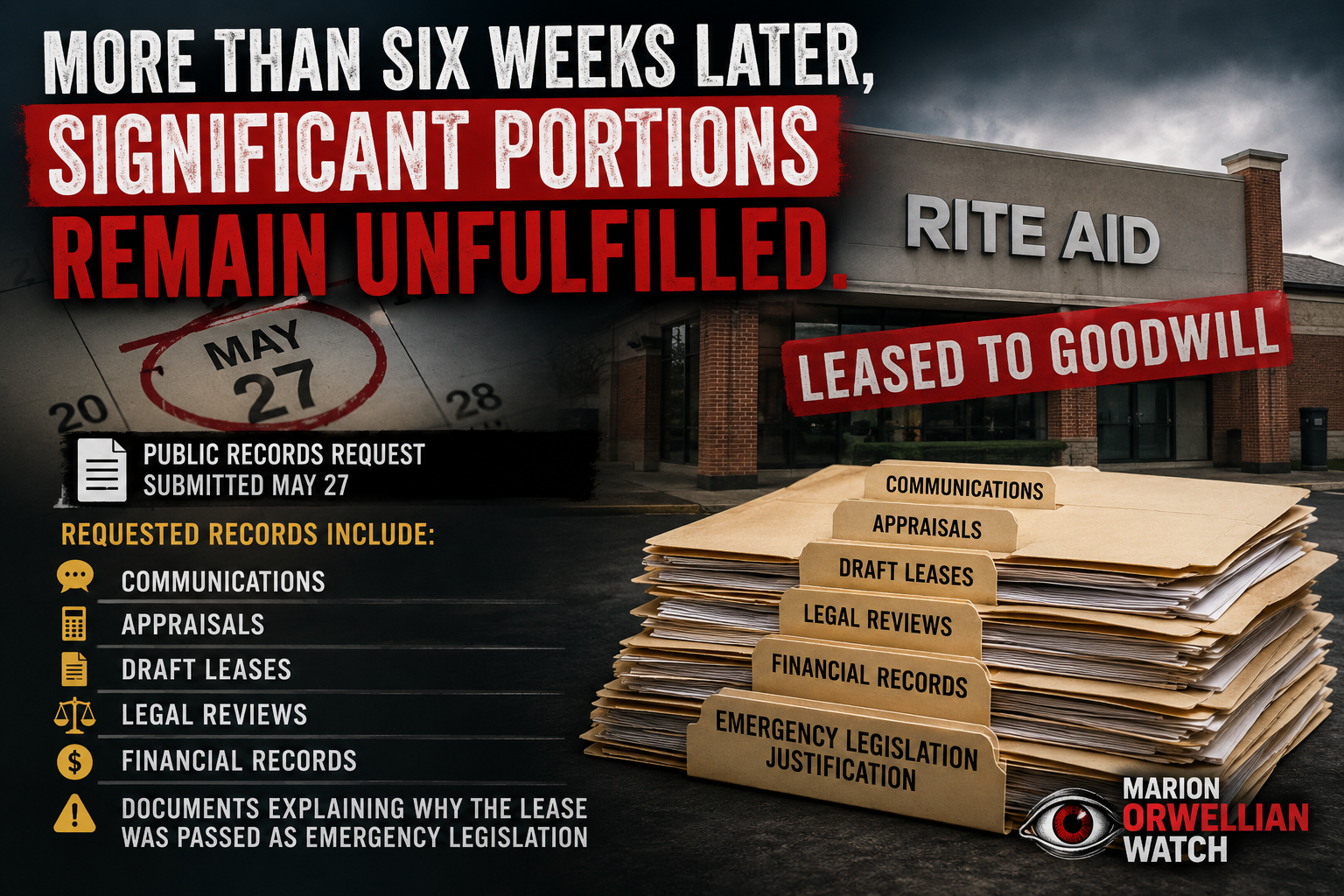
After more than six weeks, major portions of a public records request involving the former Rite Aid property and Marion Goodwill lease remain unfulfilled.
More than six weeks after I submitted a public records request concerning the City of Marion’s purchase of the former Rite Aid property and its subsequent lease to Marion Goodwill, significant portions of that request remain unfulfilled.
The request was originally submitted to the City of Marion on May 27, 2026.
It sought records from multiple city offices involved in the property purchase, the proposed conversion of the building into a fire station, and the later decision to lease the property to Goodwill as a processing and sorting facility.
The requested records included communications, appraisals, market-rent information, draft leases, legal reviews, financial analyses, feasibility studies and documents explaining why the lease was considered so urgent that it was passed as emergency legislation.
Although the City acknowledged the request on May 29, the latest correspondence raises questions about when several city offices were actually notified and whether the City believes residents must independently identify and contact every department that might possess responsive records.
City Says Some Offices Were Not Notified Until June
According to correspondence from Marion Law Director Mark Russell, several departments and offices were not notified of the request until approximately the middle of June.
That was roughly two to three weeks after the original request was submitted to the City.
The City has since taken the position that a request submitted to one municipal office does not necessarily bind other departments unless the municipality has formally created a centralized public-records clearinghouse.
Under that interpretation, a resident requesting records involving several city departments may be expected to separately deliver the request to each individual office.
That position is particularly troubling in a case like this one.
The former Rite Aid purchase and Goodwill lease involved the mayor’s office, the safety/service director, the law director, City Council, the clerk of council, the fire department and potentially outside attorneys or consultants.
The public should not be expected to understand the City’s internal organization better than the City itself.
When a request clearly identifies a city project and the offices likely to possess responsive records, forwarding that request to the appropriate custodians should be a basic administrative function—not a procedural trap used weeks later to dispute when the request was received.
Thousands of Files Identified, but Few Answers Provided
The City has stated that an electronic search using the identified keywords returned more than 3,000 files.
Officials have cautioned that many of those files may contain only a single keyword and may not actually be responsive.
That may be true.
However, it also confirms that a substantial body of potentially relevant electronic material exists and must be reviewed.
The City has not provided a clear schedule for completing that review or producing responsive records on a rolling basis.
Instead, I have repeatedly received explanations about the volume of material and the time required to review it.
Public-records requests can certainly require reasonable review and redaction. But the existence of a large number of records does not eliminate the obligation to provide responsive documents within a reasonable period of time.
It should also not prevent the City from producing records in batches as they are identified and reviewed.
A $200 Box of Paper Records
The City also identified a bankers box reportedly containing approximately 4,000 pages of fire-station designs, drawings and other documents.
At five cents per page, the estimated copying cost would be approximately $200.
It remains unclear how much of that material is actually responsive to the request or whether electronic versions of the same plans and documents exist.
For a modern construction and design project, it would be reasonable to expect that at least some architectural plans, communications, estimates and feasibility materials were created or transmitted electronically.
The request was not for thousands of unnecessary paper copies. It was for access to the responsive records, preferably in their existing electronic format when available.
The City should identify which records exist electronically, which exist only on paper and which portions of the box are actually responsive before expecting a requester to pay for every page.
No Legal Analysis of the Property Lease Provided
One of the requested categories involved any legal research, memoranda or analysis concerning Ohio Revised Code 721.03 and whether it applied to the lease of the former Rite Aid property.
The City’s response was that no such records exist because its position is that the statute does not apply.
That answer creates an obvious question.
If the City reached a legal conclusion that the statute did not apply, was that conclusion researched, discussed or communicated anywhere?
A government body may ultimately decide that a law does not apply. But when public property is being leased through emergency legislation, the public has a legitimate interest in understanding how that conclusion was reached.
If there truly are no memoranda, emails, notes or other records documenting the analysis, the public is left with only the City’s final assertion and no meaningful record of the reasoning behind it.
The Deadline Was Extended in Good Faith
I originally gave the City until July 1 to provide the remaining records or a meaningful update.
On June 29, after receiving additional communication and assurances that progress was being made, I extended that deadline until July 7.
I did so because I would genuinely prefer not to take this dispute to court.
Court action costs time, money and public resources. It should not be necessary to obtain records that belong to the public.
However, cooperation requires more than occasional status updates. It requires actual production, clear explanations and reasonable timelines.
The extended deadline passed without the complete production of the requested records.
Before moving forward, I sent another message to the law director, mayor and members of City Council asking whether any additional records could be released or whether there were further updates.
I explained that unless the remaining records or a sufficient response were received by 3 p.m. on July 7, I intended to serve a public-records complaint against the City.
This Is About More Than One Request
This dispute is not simply about a box of documents or several thousand electronic files. It is about whether Marion residents can meaningfully examine how public officials make decisions involving public property and taxpayer money.
The former Rite Aid property was purchased in November 2024 using fire levy funds. The publicly stated purpose was to expand or relocate fire department operations. The project was later placed on hold because of insufficient funding.
Then, in May 2026, the City moved quickly to lease the property to Marion Goodwill for approximately $4,000 per month. The lease was introduced as emergency legislation and described as extremely time-sensitive.
The public has a right to examine the documents behind that rapid change in direction.
What feasibility studies were completed?
What was the estimated cost of converting the building into a fire station?
When did officials begin discussing the lease with Goodwill?
How was the rental amount determined?
Was the property appraised?
Were comparable rental rates reviewed?
Why was emergency legislation necessary?
Those are not unreasonable questions. They are exactly the types of questions Ohio’s public-records law exists to help citizens answer.
Transparency Should Not Require Persistence Without End
I have tried to resolve this matter without litigation. I have clarified the request, narrowed questions, extended deadlines and repeatedly asked whether additional records could be produced.
But transparency cannot depend entirely on whether a resident is persistent enough to continue asking.
Those who know me know that persistence is not something I lack—especially when I believe the public’s right to know is at stake.
Still, no resident should have to spend six weeks following up with multiple officials, debating internal departmental responsibilities and preparing a court complaint simply to learn how public property was evaluated and leased.
The City still has an opportunity to provide the remaining records and resolve this matter without prolonged litigation. But each additional delay makes one thing clearer:
The greatest obstacle to public trust is not scrutiny. It is the continued refusal to provide the information that would allow the public to determine whether that trust is deserved.
Decorum Changes Tabled Again After Residents and Council Members Question Their Purpose
By Ashton Seales
Proposed rules still fail to address the unruly gallery behavior originally cited as the reason for changing them
Marion City Council’s proposed decorum changes stalled once again Monday night after residents and council members raised a question that committee supporters have repeatedly struggled to answer:
What problem would these new rules actually solve?
The July 6 meeting of the Legislation, Codes, and Regulations Committee listed the proposed amendment to Rule 27 of Marion’s council rules as old business. The committee consists of Ralph Smith, Scott Crider and Dan Clark.
By the end of the discussion, two of the committee’s three members voted to table the measure rather than send it to the full City Council.
For now, the proposal will not advance.
Crider Questions the Language and the Timing
Council Member at Large Scott Crider signaled his opposition almost immediately, raising concerns about both the wording of the proposal and the timing of the effort.
Several residents then approached the podium to address the proposed changes.
One speaker focused on the difference between the words “may” and “shall” in language governing when the council member presiding over a meeting signals that someone may approach the podium.
That distinction is not merely grammatical.
“May” generally gives the presiding officer discretion. “Shall” generally creates a requirement. In rules controlling when citizens are permitted to approach and address their elected representatives, that difference matters.
Vague or discretionary language can be enforced differently depending on who is speaking, what that person is saying or who happens to be controlling the meeting.
Marion Already Has Decorum Rules
Other residents returned to the central problem with the proposal: Marion City Council has operated under established procedural and decorum rules for years.
The responsibility for maintaining order already belongs to the council member leading the meeting and, during regular council sessions, the president of council.
Residents questioned what rewriting or duplicating those rules would accomplish when the existing rules are not consistently enforced.
A new ordinance cannot force leadership to lead.
A new paragraph in the city code will not solve selective enforcement, hesitation from the chair or an unwillingness to address disruptions when they occur. If council leadership refuses to use the authority it already possesses, providing that same authority in slightly different language changes nothing.
The problem is not necessarily that Marion lacks rules.
The problem may be that those responsible for enforcing them have chosen not to do so.
The Missing Gallery Rules
Another resident asked committee members to explain a glaring contradiction that has followed the proposal since the decorum debate began.
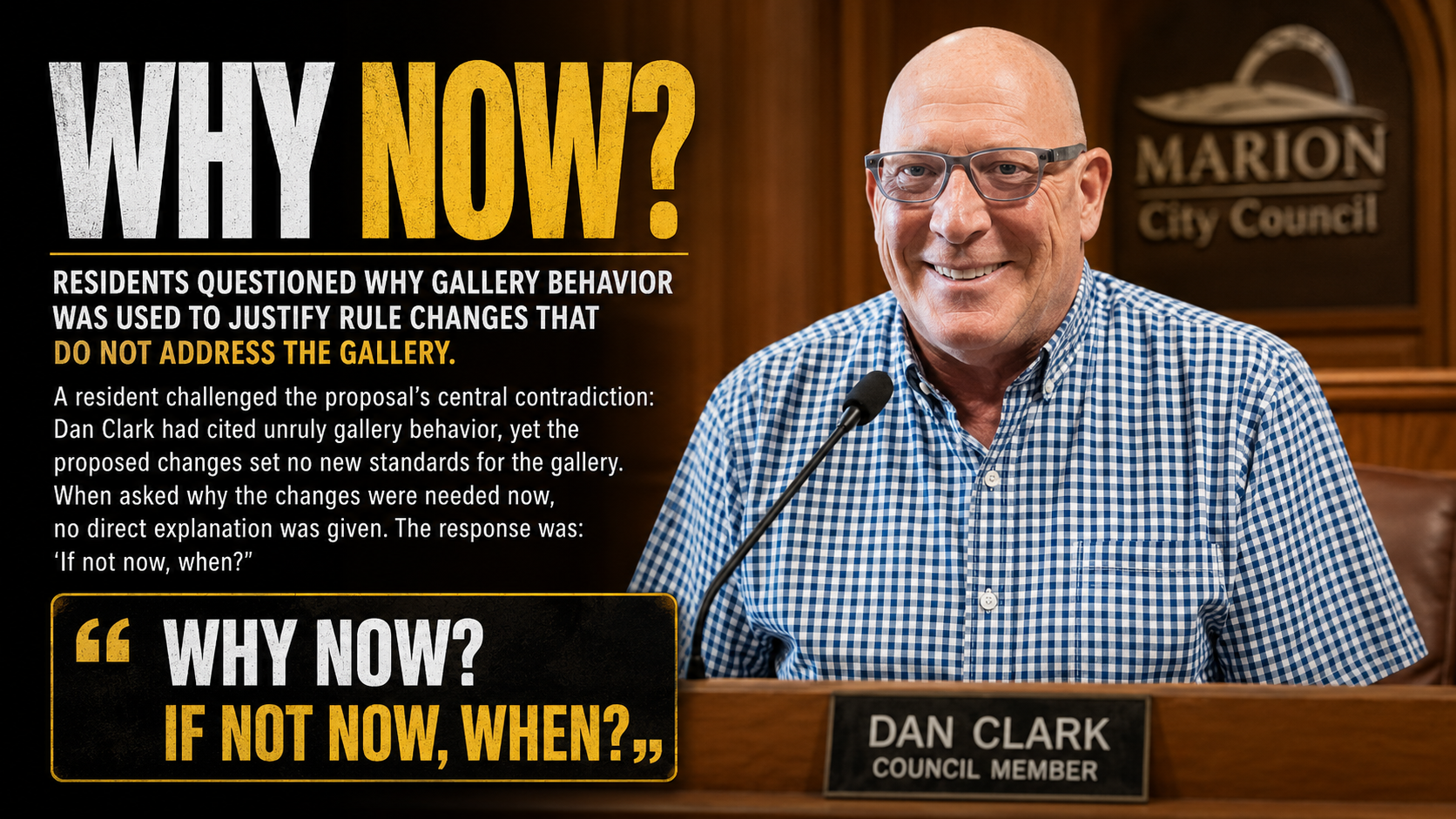
Council Member Dan Clark previously cited unruly conduct from people seated in the gallery as a reason for pursuing new rules.
Yet the proposed changes do not appear to establish any new standards specifically addressing gallery members.
The resident asked why the stated reason for the proposal was disruptive audience behavior when the proposed ordinance did not address audience behavior.
No direct answer was provided.
The resident then asked the equally important question:
Why now?
The response received was:
“If not now, when?”
But that is not an explanation of necessity.
It does not identify a deficiency in the existing rules. It does not explain what conduct the proposed language would prevent. It does not reconcile the original complaints about the gallery with an ordinance that fails to address the gallery.
“If not now, when?” assumes that the changes are necessary without first demonstrating why they are necessary.
Rollins: Codification Will Not Fix a Failure to Enforce
Council Member at Large Aaron Rollins approached the podium and echoed many of the same concerns raised by residents.
Rollins noted that the procedures council is attempting to codify are already available through its existing rules and Robert’s Rules of Order.
He also questioned what codification would accomplish if council leadership remains unwilling to enforce those standards.
Most importantly, Rollins returned to the proposal’s unexplained contradiction: the alleged conduct that started the discussion involved residents in the gallery, but the proposed ordinance does not address that conduct.
The committee was therefore being asked to advance legislation that did not appear to solve the problem used to justify its creation.
Frustration Is Not an Answer
Clark appeared increasingly agitated as residents and fellow council members continued questioning the proposal.
At one point, he threw himself backward in his chair in apparent frustration during the discussion.
What remained missing, however, was a clear explanation of why the changes were needed.
Visible frustration does not answer the public’s questions. Neither does repeating that the matter should be addressed simply because it has been discussed for several months.
When elected officials propose restrictions or additional controls affecting public participation, the burden should be on them to explain the specific problem, demonstrate why existing rules are inadequate and show how the proposed language directly addresses that problem.
That case was not made Monday night.
Two Members Vote to Table
A motion was eventually considered to move the proposed decorum changes forward to the full City Council.
Two of the three committee members instead chose to table the measure.
Tabling the proposal does not permanently defeat it. Committee members may bring it back for additional discussion or revision.
But it prevents the measure, in its current form, from advancing to council.
That matters.
The City’s official recording of the July 6 committee meetings is publicly available through its Facebook page.
Rules Cannot Replace Leadership
Marion City Council already possesses the authority to maintain order during its meetings.
The presiding officer can recognize speakers, enforce time limits, address actual disruptions and apply established rules without creating vague new provisions that may be used inconsistently.
If gallery conduct is the concern, council should explain why and propose language directly addressing gallery conduct.
If podium speakers are the concern, council should identify the specific behavior that existing rules cannot address.
If the real problem is inconsistent enforcement, council should acknowledge that changing the ordinance will not fix it.
Public meetings belong to the public. Reasonable rules may be necessary to allow government business to proceed, but those rules must be clear, narrowly applied and connected to actual disruptions - not discomfort with criticism.
For one more night, unanswered questions were enough to stop this proposal from moving forward.
It was not a permanent victory.
But it was another small victory for free speech.

More Than Just A Peanut Butter Jelly Truck: How Luke 3:11 Ministries Is Changing Lives Across Marion
By Ashton Seales
When people think about charity, they often picture food drives during the holidays or occasional community fundraisers. But tucked away on a quiet street in the middle of Marion is an organization that has made helping others a year-round mission - and one that continues to grow because of a small army of volunteers dedicated to serving their neighbors.
Luke 3:11 Ministries has become one of Marion's most impactful grassroots organizations by identifying the places where people are struggling most and finding practical ways to help. Those interested in learning more about the organization, volunteering, or making a donation can visit Luke311Ministries.org.
Whether it's delivering meals, providing laundry detergent, supplying fresh produce, helping students attend prom with confidence, or offering necessities to those experiencing homelessness, the organization has built its reputation on one simple idea: find the gaps in assistance and fill them.
During a recent visit with Marion Orwellian Watch, one thing became abundantly clear; the work being done by Luke 3:11 Ministries is extraordinary, but it depends almost entirely on volunteers.
The Peanut Butter Jelly Truck
Perhaps the organization's best-known outreach is the Peanut Butter Jelly Truck. According to its website:
"Our mission is to share our extra food with the hungry, so our family bought an antique ice cream truck to facilitate the distribution of free peanut butter jelly sandwiches to Marion, Ohio. We now have at least one of our three PBJ Trucks out in some part of Marion every afternoon of the week and serve over 30,000 meals every year."
These aren't simply sandwiches.
Families can also receive complete meal kits containing everything needed to prepare a full meal together at home, helping stretch already-tight grocery budgets while ensuring children and families have access to nutritious food.
The concept is simple, yet powerful.
Find people who need help.
Meet them where they are.
Offer assistance without judgment.
Every sandwich made, every meal packed, and every delivery completed is accomplished by volunteers who simply want to make Marion a better place.
And right now, Luke 3:11 Ministries needs more of them.
More than anything else, the organization is searching for individuals willing to spend a few hours each week helping deliver meals. Drivers - and volunteers willing to ride along with them - are among the greatest needs. Just a small commitment of time can make an enormous difference for families who have come to rely on this outreach.
Lumpy Loads of Laundry
Food isn't the only need Luke 3:11 Ministries works to address.
Through its Lumpy Loads of Laundry program, volunteers make homemade laundry detergent that is packaged in donated detergent bottles before being distributed to families throughout Marion.
According to the ministry's website:
"Lumpy Loads of Laundry consists of several laundry-related projects:
• Free Laundry Detergent! We collect empty laundry detergent jugs and refill them with homemade detergent to distribute for free to Marion's needy through our food pantry partners, Salvation Army, Be Ministries and Leapin' Outreach.
• Free Laundromat Night! We aim to host a free event at our partner Colonial Coin Laundry every month, funds permitting."
Laundry detergent is one of those necessities that often goes overlooked until families simply cannot afford it.
For households already choosing between groceries, rent, utilities, and medications, something as basic as clean clothes can become another financial burden.
Luke 3:11 Ministries helps remove that burden one bottle at a time.
The organization also hopes to one day revive another outreach that previously served some of Marion's most vulnerable residents.
At one time, volunteers would pick up laundry from individuals with disabilities who had no caregivers available to assist them. The laundry would be washed at the Luke 3:11 property before being returned clean to its owners.
Unfortunately, the program had to be discontinued; not because the need disappeared, but because there simply were not enough volunteers to sustain it.
It remains a dream the organization hopes to bring back someday.
Growing More Than a Garden
Fresh produce has long been another important part of Luke 3:11 Ministries' outreach.
In previous years, much of that produce came through generous donations.
This year marks a new chapter.
The organization has established its own community garden, allowing volunteers to grow additional fruits and vegetables that will supplement donated produce and expand the number of families they can serve.
Even the garden depends on volunteers and donations.
Watering plants.
Pulling weeds.
Harvesting vegetables.
Every task represents another opportunity for community members to invest directly in helping their neighbors.
Helping Students Celebrate Prom
Not every need involves food or household essentials.
For many teenagers, attending prom can be financially out of reach.
Luke 3:11 Ministries operates the "I Wish for Prom" program, where students can choose dresses and other formal attire free of charge, allowing them to participate in one of high school's biggest milestones without placing additional strain on family finances.
According to the ministry's website:
"Honoring a legacy of care.
Originally established in 2007 by the late Mandi Himler, 'I Wish for Prom' is a formal gown collection and donation system now proudly operated by Luke 3:11 Ministries.
Our mission is to ensure that local high school students can experience a magical prom night, completely free from financial stress. The cost of a beautiful prom dress and matching accessories shouldn't keep a student from making lifelong memories with their friends. We partner with wonderful local community spaces to provide a fun, personalized boutique shopping experience for local students at absolutely no cost."
If possible, recipients are encouraged to donate the attire back afterward so another student can enjoy the same opportunity in the future.
It's another example of the organization's philosophy that generosity has a way of multiplying when communities work together.
Caring for Marion's Most Vulnerable
Luke 3:11 Ministries also accepts donations of blankets, toiletries, hygiene products, and other everyday necessities that can be distributed to individuals experiencing homelessness or severe financial hardship.
Sometimes what people need most isn't something expensive.
It's a blanket on a cold night.
A toothbrush.
Soap.
Socks.
Basic items many people take for granted can mean everything to someone living without stable housing.
The organization works continuously to make sure those needs don't go unnoticed.
The Volunteers Behind the Mission
One of the most inspiring aspects of Luke 3:11 Ministries is that nearly everything it accomplishes is powered by volunteers.
Some make sandwiches.
Some mix homemade laundry detergent.
Others package supplies.
Some drive the Peanut Butter Jelly Trucks.
Others water the community garden or help organize donations.
Many simply show up wherever help is needed.
Perhaps most touching, according to Amy Orr Parker, is that many of the volunteers have experienced hardship themselves.
Some are people who have received help from the organization in the past.
Others are individuals currently facing difficult circumstances.
Amy shared that giving back often becomes part of their own healing journey. Helping others improves mental health, restores confidence, creates friendships, and frequently inspires volunteers to carry that same spirit of kindness into other areas of their lives.
That may be one of the most remarkable things about Luke 3:11 Ministries.
People don't simply receive help.
Many eventually become the people giving it.
The Woman Behind the Scenes
Behind much of this effort is Amy Orr Parker.
After spending time learning about the organization, Marion Orwellian Watch walked away amazed - not simply by the programs themselves, but by the person helping coordinate so many moving pieces behind the scenes.
Amy's enthusiasm for serving others appears almost limitless.
What impressed us even more is that she has continued helping lead these efforts while her spouse has been facing serious health challenges.
She was quick to credit the volunteers, insisting they keep everything running whether she is present or not.
That humility says a great deal about the culture she has helped create.
Even so, we couldn't help but be struck by the incredible amount of compassion, dedication, and perseverance it takes to continue supporting so many charitable programs during what would undoubtedly be one of the most stressful periods in anyone's personal life.
Throughout our conversation, one message continually resurfaced:
Love your neighbor.
Amy emphasized that although the organization carries the name Luke 3:11 Ministries, people from every background, belief system, and walk of life are welcomed and encouraged to volunteer.
The organization is not built around religious requirements.
Rather, it embraces what Amy described as the central message Jesus emphasized repeatedly throughout His ministry: love one another.
Just as Jesus reached those society often overlooked - the poor, the outcast, the imprisoned, the sick, immigrants, and those whom others considered "unworthy" - Luke 3:11 Ministries seeks to serve anyone in need with dignity and compassion.
No judgment.
No labels.
Just help.
Marion Needs More People Like This
Organizations like Luke 3:11 Ministries rarely make headlines.
They aren't seeking recognition.
They're simply trying to make life a little easier for families who are struggling; but they cannot do it alone. The greatest need today isn't necessarily money.
It's people.
People willing to spend an afternoon making sandwiches.
People willing to ride along on a Peanut Butter Jelly Truck.
People willing to drive one of the Peanut Butter Jelly Trucks.
People willing to water a garden.
People willing to sort donations.
People willing to give just a few hours of their week to help someone they've never met.
The needs throughout Marion are real. So is the impact volunteers can make.
If you've ever wanted to make a tangible difference in your community, Luke 3:11 Ministries offers countless opportunities to do exactly that.
Whether you can volunteer your time, donate blankets, empty laundry detergent bottles, or toiletries, contribute financially, provide fresh produce, or simply spread the word about the organization's ongoing need for volunteers, every act of generosity helps ensure these vital programs continue reaching Marion families who need them most.
Communities are strongest when neighbors look after one another - Luke 3:11 Ministries has been doing exactly that for years.
Now they're asking the community to help them continue.If you have time to volunteer, visit their website or Facebook for information on how you can help.
https://luke311ministries.org

Freedom Is Meant to Be Exercised
Why the Fourth of July Is About More Than Fireworks
A Marion Orwellian Watch Special Report
This Fourth of July, as we celebrate the birth of the United States, it's worth remembering that our nation's independence didn't begin with fireworks. It began with ordinary people refusing to remain silent.
Long before the Declaration of Independence was signed, colonists organized public meetings, wrote petitions, spoke out against government policies, and held peaceful demonstrations. The Boston Tea Party became one of the most famous acts of protest in American history; a powerful statement against taxation without representation and a demand that government be accountable to the people. The Declaration of Independence itself was, in many ways, the culmination of years of public resistance and civic action. Our nation's founders didn't simply celebrate freedom - they exercised it.
That tradition continues today.
On Friday, July 4th, from Noon until 2:00 p.m., Citizens for Democracy will hold a peaceful demonstration outside the Marion County Courthouse, 100 North Main Street, Marion, Ohio.
Whether you agree with every viewpoint expressed is not the point. The point is that peaceful protest is one of the fundamental freedoms protected by the First Amendment.
Throughout American history, public demonstrations have helped bring attention to issues that might otherwise have been ignored. From the movement for women's suffrage, to the struggle for civil rights, to countless local community causes, peaceful assembly has given ordinary citizens a voice when other avenues seemed closed.
Democracy isn't sustained by silence. It depends on citizens who are willing to participate, ask difficult questions, engage respectfully with one another, and make their voices heard.
This Independence Day, don't just celebrate the freedoms our founders fought to secure - use them. If you believe that government works best when citizens are informed, engaged, and willing to participate, stop by the Marion County Courthouse between Noon and 2:00 p.m.
Listen.
Ask questions.
Join the conversation.
Whether you stay for five minutes or the entire event, your presence is a reminder that civic participation is still alive. Because history has shown us that rights endure only when people choose to exercise them. And democracy is strongest when the people refuse to be silent.
Marion Orwellian Watch plans to participate. We hope to see you there.
Happy Independence Day.

Marion's Weather Sirens Aren't the Only Warning We Should Be Paying Attention To
By Ashton Seales
The issue surrounding Marion's outdoor warning sirens isn't really about the sirens.
It's about how residents learned what the City intended to do with them.
For many citizens, the first indication that Marion would no longer repair or upgrade its aging weather sirens wasn't during a City Council meeting, through a press release, or as part of a public discussion about emergency preparedness.
It was through a Facebook post.
Only after residents began asking questions online did the issue make its way into the June 22 City Council meeting, where the Safety-Service Director clarified an important point: the existing sirens are still operational. The City simply does not intend to repair or replace them as they fail.
That clarification mattered.
The original Facebook discussion left many residents with the impression that the sirens were simply being abandoned. Instead, the City's position is that they will continue using the current system until individual sirens fail, at which point they will not be repaired or upgraded.
Whether someone agrees with that policy is almost beside the point.
The larger question is why citizens had to learn about such an important public safety decision through social media instead of directly from their local government.
A Familiar Pattern
Unfortunately, this is beginning to feel familiar.
Over the past several months, Marion residents have repeatedly found themselves learning about significant City decisions only after someone asks enough questions.
Consider the former Rite Aid building at 332 South Main Street.
The public first learned that the City intended to lease a building purchased with fire levy funds after legislation appeared before Council. Only after public records requests did residents begin seeing the emails, lease drafts, negotiations, and timeline leading to the decision. Even today, questions remain regarding what analyses, financial reviews, and internal discussions occurred before the lease was approved.
The information eventually surfaced - but largely because citizens went looking for it.
The same pattern appeared with the City's dumpster service.
Residents learned of changes to fees and operations, yet many basic questions remained unanswered. Why were policies difficult to locate? Where were the written procedures? Why wasn't the public given a clearer explanation of how the service would operate?
Again, citizens had to piece together the answers.
The City's financial reporting tells a similar story.
Delayed financial audits and questions surrounding IRS penalties became topics of discussion only after they appeared on Council agendas. While officials addressed questions once raised, many residents were left wondering why those issues had not been proactively explained long before they reached public meetings.
Transparency Should Be Proactive
None of these examples necessarily suggest wrongdoing.
But they do suggest something equally important.
The City too often appears to communicate after public concern develops rather than before it.
Good government isn't simply responding once citizens discover an issue.
It's anticipating the questions residents are likely to have and answering them before confusion spreads.
If Marion has decided that maintaining aging weather sirens is no longer the best use of taxpayer dollars, that is a policy discussion worth having.
The City has also encouraged residents to enroll in Hyper-Reach, a notification system that can send severe weather alerts directly to cell phones and even landline telephones. For many residents, that may prove to be an effective and modern way to receive emergency notifications. Promoting Hyper-Reach is a reasonable step, and expanding emergency communications is certainly worthwhile.
But that recommendation only reinforces the need for proactive communication. If the City's long-term strategy is to transition away from outdoor warning sirens and toward direct notification systems like Hyper-Reach, residents deserve to hear that explanation from City officials - not first through a Facebook post. A change involving public safety should begin with a public conversation, not online speculation.
Perhaps advances in wireless emergency alerts, weather apps, and other notification systems have reduced the need for outdoor sirens. Perhaps replacement costs are prohibitively expensive. Perhaps there are other priorities competing for limited resources.
Those are legitimate discussions.
But they should happen publicly - not after a Facebook post creates uncertainty.
Public Trust Depends on Communication
Residents shouldn't have to monitor social media to learn about significant changes involving public safety, city finances, or taxpayer-funded assets.
The same principle applies whether discussing emergency sirens, the Goodwill lease, city financial audits, IRS penalties, or changes to municipal services.
Transparency is more than posting documents online.
It means explaining decisions, providing context, and giving citizens an opportunity to understand why those decisions are being made.
Marion's weather sirens may continue sounding for years to come.
But the conversation surrounding them should serve as another reminder that effective communication is one of the most important public safety tools any city has.
When citizens consistently learn about important government decisions after the fact - or only because someone asks the right question - it becomes harder to build the public trust that every local government depends upon.

Public Records Request Nears One Month As Questions About the City's Search Continue
Marion Orwellian Watch
Nearly one month has passed since The Orwellian Watch submitted a public records request seeking documents related to the City of Marion's purchase and subsequent lease of 332 South Main Street. What should have been a straightforward request for public records has instead raised broader questions about how the City processes records requests and whether responsive records are being searched for comprehensively.
A Fragmented Response
Rather than receiving a coordinated response from the City as a single public office, records have been produced piecemeal by individual departments over the course of several weeks.
In many instances, departments responded only for themselves, often indicating what records they did or did not possess, without any indication that the request had been forwarded to every office, official, or employee reasonably likely to maintain responsive records. This approach effectively places the burden on the requester to determine which department may possess a particular document. A burden that Ohio's Public Records Act does not place on citizens.
When a request seeks records involving a major municipal transaction, responsive records may reasonably exist in multiple locations, including the Mayor's Office, the Law Director, the Safety-Service Director, Finance, the Clerk of Council, economic development personnel, outside consultants, or individual employees involved in negotiations. Emails, text messages, memoranda, drafts, legal reviews, meeting notes, and financial analyses are often created and maintained by different custodians. Without a coordinated search, there is no way for the public to know whether all responsive records have actually been identified.
As additional responses were received, it became increasingly apparent that categories of records reasonably expected to exist had not been produced. Some records referenced in other documents were absent altogether, while other categories of requested documents were not addressed in any response.
This raised an obvious question: Were those records determined not to exist after a reasonable search, or were they simply never searched for?
Rather than receiving an explanation describing the scope of the City's search, Marion Orwellian Watch was left to piece together responses from multiple departments while attempting to identify which offices had searched, which had not, and whether any central coordination had occurred.
Transparency should not require citizens to act as investigators simply to determine whether a public office has completed a reasonable search for public records. The responsibility to identify, locate, and produce responsive records rests with the public office itself - not the requester.
What Has Been Found So Far
Despite the ongoing gaps in production, some records have been provided through departmental responses over the course of this request.
Those records generally reflect limited, department-specific production (known as siloed) rather than a single consolidated release. In other words, what has been received so far appears to represent individual pieces of the broader record rather than a complete file of all materials related to the property acquisition and lease.
Among the categories that have been partially addressed are basic transactional and administrative records, along with select communications held within certain departments. These materials provide some insight into the City’s handling of the property but do not, on their own, appear to constitute a complete record of the decision-making process.
Notably, the piecemeal nature of the responses makes it difficult to determine whether additional responsive records exist elsewhere within the City’s systems but have not yet been located or produced. Some responses indicate that certain departments do not possess responsive records, while other categories have not been specifically addressed in detail.
As a result, the current production provides fragments of information rather than a unified record of how the acquisition, financing, legal review, and lease arrangement were developed and approved. Without a consolidated response or a clearly described search methodology, it remains unclear whether the City’s production represents the full universe of responsive records or only those located within initial departmental searches.
Clarifying - Not Restarting - The Request
As it became apparent that significant categories of records had not been produced, Marion Orwellian Watch submitted a refined follow-up request.
The purpose was not to submit a new request, but to eliminate any ambiguity by identifying specific record types, custodians, and departments that should be included in the City's search.
Clarifying a request after receiving incomplete responses should not relieve a public office of its obligation to produce records responsive to the original request within a reasonable amount of time.
Records Still at Issue
Among the records requested are:
- Internal communications regarding the lease.
- All Communications with Marion Goodwill Industries.
- Draft lease agreements and revisions.
- Legal review and opinions concerning the transaction.
- Financial analyses and supporting documentation.
- Appraisals or market rental evaluations.
- Documentation regarding the acquisition and intended use of the property.
- Communications among City officials concerning the lease and negotiations.
To date, many of these categories have either not been produced or have not been addressed.
If responsive records do not exist, the City can simply state that after conducting a reasonable search. However, if records do exist, Ohio law generally requires that they be produced unless a specific legal exemption applies.
Why This Matters
Public records law exists for a simple reason: citizens must be able to see how government decisions are made, especially when those decisions involve public property, public funds, and long-term commitments that affect taxpayers.
When records are produced in fragments - without clarity on what was searched, which offices were included, or how the search was conducted - it becomes difficult to distinguish between records that do not exist and records that have simply not been located yet.
That uncertainty, even if unintentional, undermines the purpose of transparency law itself.
The issue is not limited to whether a document is eventually produced. It also involves the integrity of the process used to determine whether that document exists in the first place. A “reasonable search” under Ohio law is not satisfied by checking a single inbox, a single department, or a limited set of custodians when multiple offices are reasonably likely to be involved in a transaction.
When major municipal actions involve coordination between administration, legal counsel, finance, and external parties, responsive records are often distributed across multiple systems and individuals. Without a coordinated effort, critical context can be missed - not because it was withheld, but because it was never located.
That distinction matters.
Because from the outside, the public sees only the end result: incomplete productions, unanswered categories of requests, and uncertainty about whether the full record has been assembled.
Over time, this pattern can erode trust even in routine matters. Residents are left unsure whether delays reflect administrative burden, unclear internal processes, or something more systemic in how records are managed and retrieved.
Ultimately, public records requests are not meant to be adversarial. They are meant to provide clarity. When the process itself becomes unclear, it shifts the burden away from government transparency and onto the public to interpret gaps, reconcile inconsistencies, and infer what may or may not exist.
That is why the manner of response is just as important as the records themselves. Without a demonstrably coordinated and complete search, even responsive disclosures may fail to fully satisfy the purpose of Ohio’s Public Records Act: ensuring that government remains open, accountable, and verifiable through documentation.
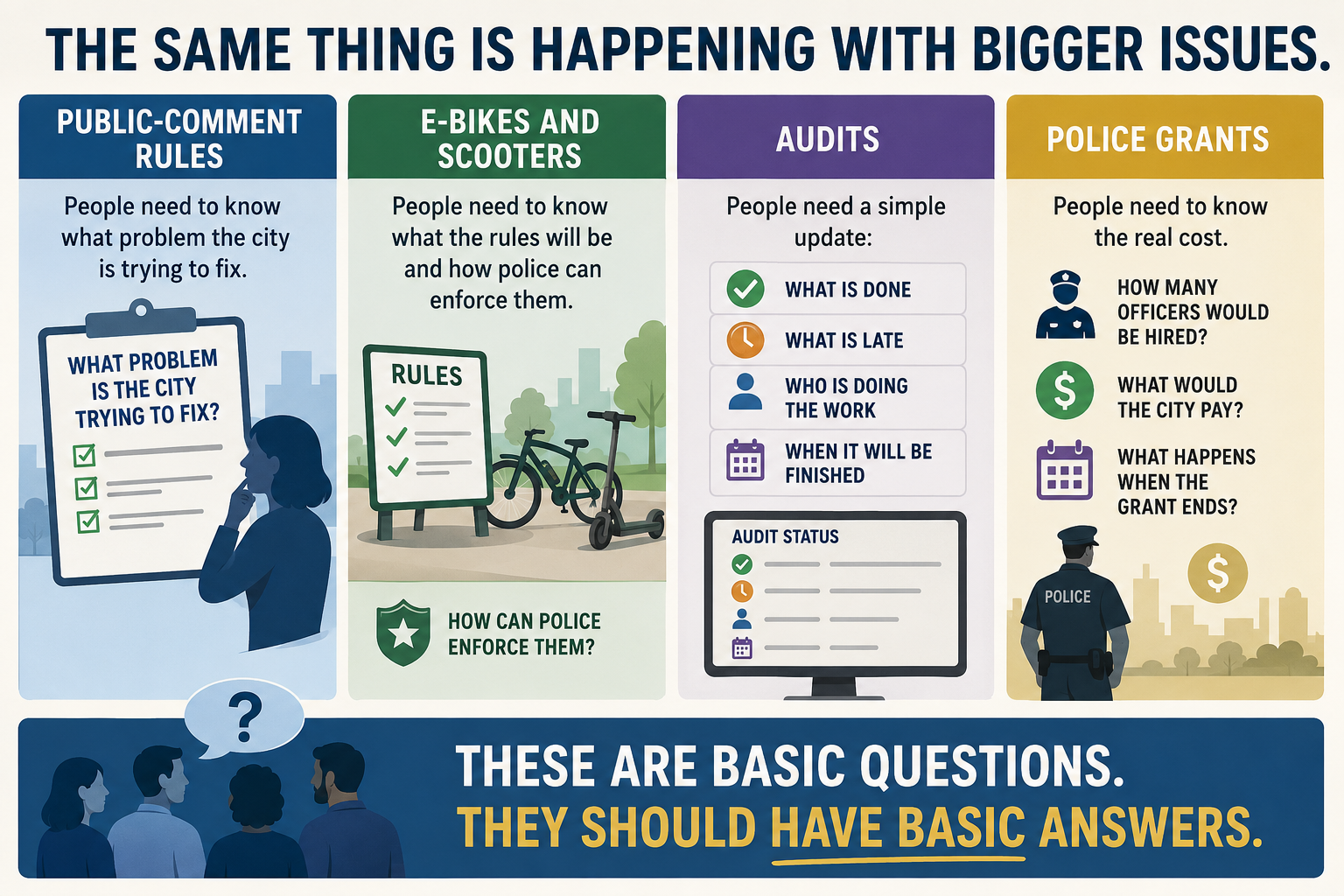
Marion Does Post Records. That Is Not The Same As Explaining Itself.
By Michael Grubbs
People keep showing up to Marion City Council meetings with the same basic problem.
They are not just asking for a vote.
They are asking what the city is doing, why it is doing it, how much it will cost, and what happens next.
That is not unreasonable.
It is what local government is supposed to make clear.
At the June 15, 2026 Marion City Council committee meeting, this showed up again and again. Council discussed proposed public-comment rule changes, e-bike and scooter regulations, delayed audits, IRS penalty questions, park grants, and a federal police hiring grant.
Those are not small topics.
They affect speech at public meetings, safety on streets and sidewalks, city finances, and police staffing.
The public should not have to decode all of that from scattered PDFs, short committee answers, and meeting-room back-and-forth.
They also should not have to wait days to see what happened.
Marion does provide some public access. But compared with other Ohio cities, Marion appears to fall short on something just as important: usable transparency.
~Posting A PDF Is Not The Same As Explaining A Decision~
Marion has an agenda center. It posts agendas and minutes for city boards and commissions.
Marion also has pages for ordinances and resolutions. Some files are searchable by year, and the city says residents can email the clerk for help with searches or to request files on a flash drive.
There is a public-records request form, and the form correctly says residents do not have to use the form, give their identity, or explain why they want the records. The city also links people to Comprehensive Annual Financial Reports through the Ohio Auditor’s Office.
Those things matter.
But they do not fully solve the problem.
The question is not only whether a document exists somewhere.
The question is whether an ordinary resident can understand what is happening without already knowing how City Hall works.
On that test, Marion looks weaker than several other Ohio cities.
~Other Ohio Cities Make Meetings Easier To Follow~
Some cities make it much easier for the public to connect the agenda, the video, the minutes, and the decision.
Lima has a public video archive where meetings are listed by date and duration, with direct links to the video and agenda. A resident can quickly see which meeting happened, how long it was, and where to watch it. Hudson has a page specifically for City Council agendas, minutes, and videos. It points residents to live meetings and archived meeting materials in one place.
Marysville goes even further. Its meeting pages explain that video is not the official record, but still provide live and archived meetings. A sample archived meeting includes a full agenda, transcript, video index, and download options. That means residents can jump straight to the part of the meeting they care about. Wilmington, Ohio has a public meetings portal with upcoming meetings, meeting types, recently completed meetings, and a meeting archive. Its City Council page also links to meeting packets by year.
Delaware has an agenda and motion-summary page, public-comment archives by year, live webcast and video links, city budget links, and other civic information gathered in a way that is easier to navigate. None of these cities are perfect. But they show what better public access can look like.
Not just a file.
Not just a meeting.
A trail the public can actually follow.
~Marion’s Problem Is Usability~
Marion’s transparency problem is not that everything is hidden.
That would be too simple. The problem is that too much of the process still feels like: Here are the documents. Figure it out.
And when video is not posted quickly in a clear official archive, the problem gets worse. Residents who cannot attend a meeting should not have to wait several days, or rely on someone else in the room who happened to record and upload the meeting, just to find out what was discussed.
That is not real-time public transparency.
That is delayed access.
Delayed access matters because council business moves. By the time a video becomes easy to find, the public may already be behind the next agenda, the next committee discussion, or the next vote. That is a problem when the city is talking about public-comment rules, delayed audits, IRS penalties, police grants, and e-bike enforcement.
At the June 15 committee meeting, the Rule 27 discussion raised basic questions about public speech. What problem is the city trying to fix? Is it about people speaking too long? Is it about people interrupting? Is it about decorum? Is it about content? Will residents know the rules before they speak? Will there be a visible timer?
Those are not technical side questions.
They are the point.
The public deserves a plain explanation of why the rule is being changed and how it will work. The e-bike discussion had the same issue. Council members talked about safety, kids riding motorized vehicles, age rules, definitions, and whether police could realistically enforce the ordinance.
Again, the public question is simple:
What exactly is the city trying to prevent, and what rule would actually help?
The finance discussion raised even bigger questions. The city is still working through delayed audits and reconciliations. The June 15 meeting included a status update that 2022 was close to finished, with 2023, 2024, and 2025 still behind it. Residents should not have to piece together the audit situation from committee comments. The city should have a plain public dashboard or status page that says:
-which audits are complete,
-which reconciliations are complete,
-what is still pending,
-who is doing the work,
-what the current deadline is,
-and what changed from the last update.
That would not be radical.
It would be basic public accountability.
~Grants Need Plain Explanations Too~
The June 15 Finance Committee also discussed a federal COPS hiring grant.
That may sound like free money.
It is not that simple.
The discussion included a possible 25 percent match, a waiver request, a three-year grant period, and a one-year retention period afterward. There were also questions about whether the city could afford the officers after the grant period. That is exactly the kind of issue that needs a public explainer. Residents should be able to see the answer to basic questions before council votes:
~How many officers would this fund?
~What would the city pay each year?
~What happens after the grant ends?
~What if the waiver is denied?
~What happens if the city cannot afford the retention period?
~How does this fit with the city’s recovery plan and delayed audits?
That is not anti-police.
That is not anti-grant.
That is basic math.
~Better Transparency Would Help The City Too~
This is where City Hall may be missing the point. When residents ask more questions, that does not always mean they are trying to stop everything. Sometimes it means they are trying to understand.
If the city explains more clearly, it may actually lower tension in the room.
A public-comment rule is easier to trust when the city explains the problem, the legal limits, and the rights residents still have.
An e-bike ordinance is easier to accept when the city explains the safety issue, the enforcement plan, and the education plan.
A police grant is easier to evaluate when the city explains the real future cost.
An audit update is easier to believe when the city posts a clear timeline and keeps updating it.
Meeting video is more useful when it is posted quickly, in an official place, next to the agenda and minutes.
Transparency is not just about avoiding scandal. It is about making government understandable enough that residents can participate before decisions are already moving.
~The Standard Should Be Higher~
Marion should not settle for the bare minimum.
If other Ohio cities can provide integrated meeting archives, video links, agenda packets, transcripts, indexes, public-comment archives, budget links, and easier navigation, Marion can improve too.
We, the citizens of the City of Marion, are asking City Council to:
-Put each meeting’s agenda, packet, video, minutes, and related laws on one page.
-Post meeting video or audio quickly in an official city archive.
-Add short, plain summaries for major votes, grants, rules, and money items.
-Post Meeting Minutes for all applicable City public meetings
-Create a public audit status page and update it often.
-Add timestamps so people can find the part of a meeting they need.
-Make public-records and city-service information easy to find.
-Explain what happens next after committee meetings.
Marion already has many pieces online.
Now the city needs to put them together in a way people can actually use.
Residents are not just asking for records.
We are asking for answers.
References:
City of Marion Agenda Center https://www.marionohio.us/AgendaCenter/City-Council-7
Lima video archive https://limaoh.new.swagit.com/views/699/
Hudson City Council Agendas, Minutes, Videos https://www.hudson.oh.us/814/Council-Agendas-Minutes-Videos
City of Marion Council Resolutions https://www.marionohio.us/183/Council-Resolutions
City Council of Marion Public Records Request form https://www.marionohio.us/.../View/8949/Records-Request-PDF
City of Marion Reports https://www.marionohio.us/236/Reports
Marysville Live & Archived Meetings Sample meeting page https://www.marysvilleohio.org/588/Live-Archived-Meetings
Wilmington Public Meetings Source: Wilmington City Council Meetings https://wilmingtonohio.gov/departments/public-meetings/
Delaware Agendas & Motion Summaries https://www.delawareohio.net/.../agendas-motion-summaries
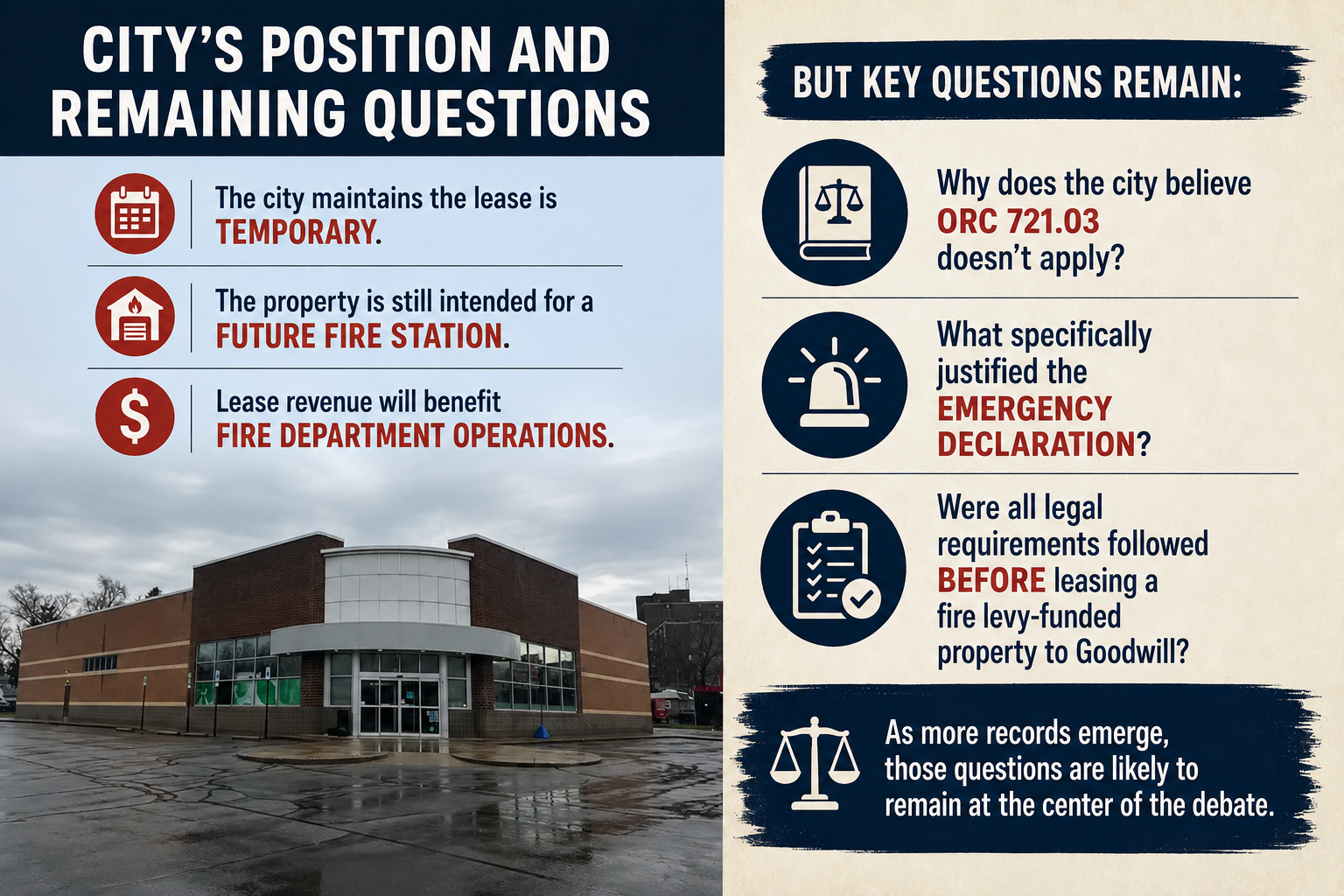
Marion Defends Goodwill Lease as Questions Grow Over Emergency Approval and State Law Requirements
By Ashton Seales
6/16/26
Newly released records concerning Marion's lease of the former Rite Aid property to Marion Goodwill Industries have revealed not only how the agreement was negotiated, but also a growing dispute over whether Ohio law governing the lease of municipal property applies to the arrangement at all.
The property at 332 S. Main Street was purchased using fire levy funds and publicly presented as the future site of a new fire station. In June, however, Marion City Council approved an emergency ordinance authorizing a lease of the building to Marion Goodwill Industries for use as a processing center.
Since then, questions have been raised regarding both the emergency approval process and whether the city complied with Ohio Revised Code 721.03, a statute governing the lease of municipal property.
City officials now maintain that ORC 721.03 does not apply to the Goodwill agreement.
That position has sparked additional questions about how the city reached that conclusion and whether taxpayers received the protections the statute was designed to provide.
What ORC 721.03 Requires
Ohio Revised Code 721.03 generally allows municipalities to lease property that is not currently needed for municipal purposes.
The statute also contains procedural requirements, including the adoption of an ordinance identifying the property and lease terms and publication requirements before the lease can be finalized.
Supporters of applying the statute argue that the former Rite Aid property appears to fit the description of municipal property not currently being used for its intended public purpose.
The city, however, has taken the position that ORC 721.03 does not govern this particular transaction.
To date, officials have not publicly provided a detailed legal explanation outlining why they believe the statute is inapplicable.
Emails Show Lease Negotiations Began Before Council Approval
Records obtained through public records requests show lease negotiations were already underway before council considered the proposal.
On May 19, Mayor Bill Collins informed Goodwill representatives that he had a draft lease prepared and requested feedback on potential changes.
The following day, Law Director Mark Russell provided a draft ordinance authorizing the agreement in preparation for council consideration.
The emails show that both the lease and authorizing legislation were being developed before council voted on the proposal.
That timeline is not unusual for municipal transactions. However, it does demonstrate that the agreement was being actively negotiated prior to legislative approval.
Emergency Ordinance Raises Additional Questions
Council ultimately approved the lease through an emergency ordinance.
The legislation stated that immediate action was necessary due to "the need to move forward without delay in this extremely time sensitive matter."
The ordinance did not identify a specific emergency, public safety threat, financial deadline, or unforeseen circumstance requiring immediate action.
Instead, it referred to a "unique opportunity" benefiting both the city and Goodwill.
The newly released emails provide insight into why officials may have wanted to move quickly.
Goodwill representatives repeatedly expressed an urgent need for space. At one point, Goodwill's attorney wrote that the organization was "busting at the seams" and hoped to occupy the building immediately upon execution of the lease.
The records clearly demonstrate urgency on Goodwill's side of the transaction.
What remains less clear is whether that urgency constituted the type of emergency contemplated by Ohio law when normal legislative procedures are bypassed.
Negotiations Continued After the Vote
The emails also reveal that negotiations continued long after the emergency ordinance was introduced.
Attorneys exchanged revisions to letters of intent, lease language, occupancy dates, maintenance responsibilities, insurance provisions, and other terms.
As late as June 10, city and Goodwill attorneys were still discussing final lease language and awaiting what the city's law director described as its remaining approvals.
One email from the law director referenced the city still needing to check its "last two boxes" before final approval could occur.
The continued negotiations raise a practical question: if the matter required emergency legislative treatment, why were substantial revisions and approvals still occurring weeks afterward?
Fire Levy Property Being Used for Economic Development
The records also provide insight into how city officials view the arrangement.
In correspondence seeking approval from the Community Improvement Corporation, Law Director Mark Russell described the lease as an economic use of the property while awaiting future construction of a fire station.
He stated that the city was "not selling the property" but was instead utilizing it economically during the period before construction begins.
Russell further stated that lease proceeds would be directed toward fire department operating expenses.
That explanation appears to form the foundation of the city's position that the property remains connected to its original fire department purpose despite the temporary lease arrangement.
Questions That Remain
The newly released records answer some questions about how the Goodwill lease was negotiated. They also create new ones.
Among them:
Why does the city believe ORC 721.03 does not apply to the lease?
Has the city produced a formal legal opinion supporting that conclusion?
What specific facts justified emergency treatment of the ordinance?
Were council members provided the full lease before voting?
Was any market-rate analysis performed before agreeing to lease terms?
What is the timeline for construction of the proposed fire station?
If the property remains intended for fire department use, at what point does a temporary lease become inconsistent with representations made to voters?
The documents show city officials worked closely with Goodwill to move the agreement forward quickly. What remains unresolved is whether the legal framework used to authorize the lease was the correct one - and whether the public received the level of transparency and procedural safeguards that Ohio law intended.
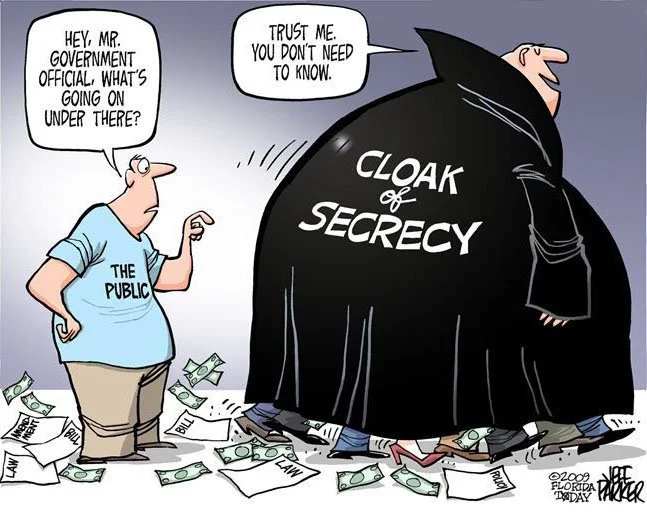
Update: New Emails Add To Silver Street Annexation Timeline
New county records show the proposed Dollar General was being discussed earlier and more directly than previously documented.
By Michael Grubbs
Project: Silver Street annexation
Published draft date: June 1, 2026
Marion Orwellian Watch previously reported that the Silver Street annexation raised questions about cleanup, ownership, emergency legislation, and a proposed Dollar General development.
That earlier article found that the "emergency" language appeared tied to Ohio's annexation timeline, not to a newly documented emergency at the property. It also noted that residents were trying to understand how the former tire site, cleanup funding, probate issues, annexation, zoning, and possible development fit together.
New records received from the Marion County Commissioners do not replace that earlier finding. They add a more specific timeline around the proposed Dollar General project and show why residents' questions about the process deserved a clearer public answer.
## The New Records Move The Timeline Back
The new emails show that the Dollar General project was being discussed well before the annexation appeared on the March 2026 City Council agenda.
In April 2024, Marion County Commissioner Mark Davis referred to getting refocused on the "Dollar General deal with Logan Tire." In May 2024, the developer wrote that they were ready to put the property in contract and move forward. Davis then provided seller contact information.
That does not show that the later annexation vote was improper. But it does show that the Dollar General project was active in official and economic-development conversations long before the public annexation process reached council.
## Support For The Project Was Being Organized
A May 30, 2024 email from Marion CAN DO, Marion's local economic-development organization, said Dollar General was in the process of acquiring the parcel north of Logan Tire and that development would require annexation into the city for sanitary sewer and rezoning.
The email also said the developer was nervous because other communities had seen Dollar General-related annexations denied after residents objected. It said the annexation petition would be submitted with a project name to keep anxiety low because Dollar General did not want another annexation with its name denied.
The same email asked local leaders to reassure the developer that the community was supportive and said neighborhood and business support could add another layer of backing for the project.
That matters because later public concerns were sometimes answered as though residents were trying to stop "something good" from happening. The emails show that support-building for the project was already being discussed before residents raised many of their questions in public meetings.
## Public Assistance Was Discussed
The new records also show discussion of possible public help tied to the proposed store.
In September 2025, Marion Mayor Bill Collins emailed the developer and said the city, Marion County Commissioner Mark Davis, and a township representative had been working on ideas for the property. Collins wrote that the city had workers and equipment capable of cutting brush and trees to make the property more visible from State Route 309, and that Davis had identified $7,000 in county economic-development funding that could cover the city's cost.
Collins also wrote that the city would not do the work unless the parcel was purchased for construction of the store. He said a letter could be prepared saying the city would cut the trees once the purchase was completed.
A separate draft county resolution discussed using up to $7,000 from a CDBG revolving loan fund to remove vegetation from the right of way near the proposed Dollar General store. The draft described the project as an economic-development project in a low- and moderate-income neighborhood.
An October 2025 internal county email adds that at least one commissioner was described as not supporting help for Dollar General because of concern that the store could take business from local businesses. Another county response said the resolution was not needed yet because officials were expected to write a letter approving the work contingent on Dollar General buying the property.
The records reviewed so far do not establish that public money was ultimately spent. They do show that public labor, public funding, and a conditional letter tied to the store purchase were being discussed before the annexation reached council.
## Was Dollar General Driving The Cleanup?
The new emails make this question sharper, but they do not answer it completely.
The records do not prove that Dollar General was the only reason cleanup happened. The tire problem existed before the development discussions, and public health records already showed enforcement and ownership problems connected to the site.
But the emails do show that Dollar General became a major factor in how officials and development contacts talked about the property. By 2024 and 2025, cleanup, visibility from State Route 309, sewer access, annexation, and the proposed store were being discussed together.
That makes it fair to ask whether cleanup priorities were being influenced by the goal of making the site workable for Dollar General, even if the public-health problem was real on its own.
## Why This Update Matters
The original article focused on whether the annexation's emergency language appeared to mean a real emergency at the property. The newer records point to a different accountability issue.
Residents were not just asking about a store. They were asking how public cleanup, private development, city annexation, sewer access, and possible public assistance fit together.
The new emails show that some officials and development contacts had been working through those pieces well before the public annexation votes. That does not prove wrongdoing. It does show that residents were asking reasonable questions about a process that had more history behind it than the public agenda made clear.
## Sources Reviewed
- Original Marion Orwellian Watch article on the Silver Street annexation.
- City of Marion council agendas and meeting materials for March 23, April 27, May 11, and May 26, 2026.
- Ohio Revised Code Section 709.023.
- Records received through public records requests to Marion Public Health, the Marion City/County Regional Planning Commission, and the Marion County Commissioners.
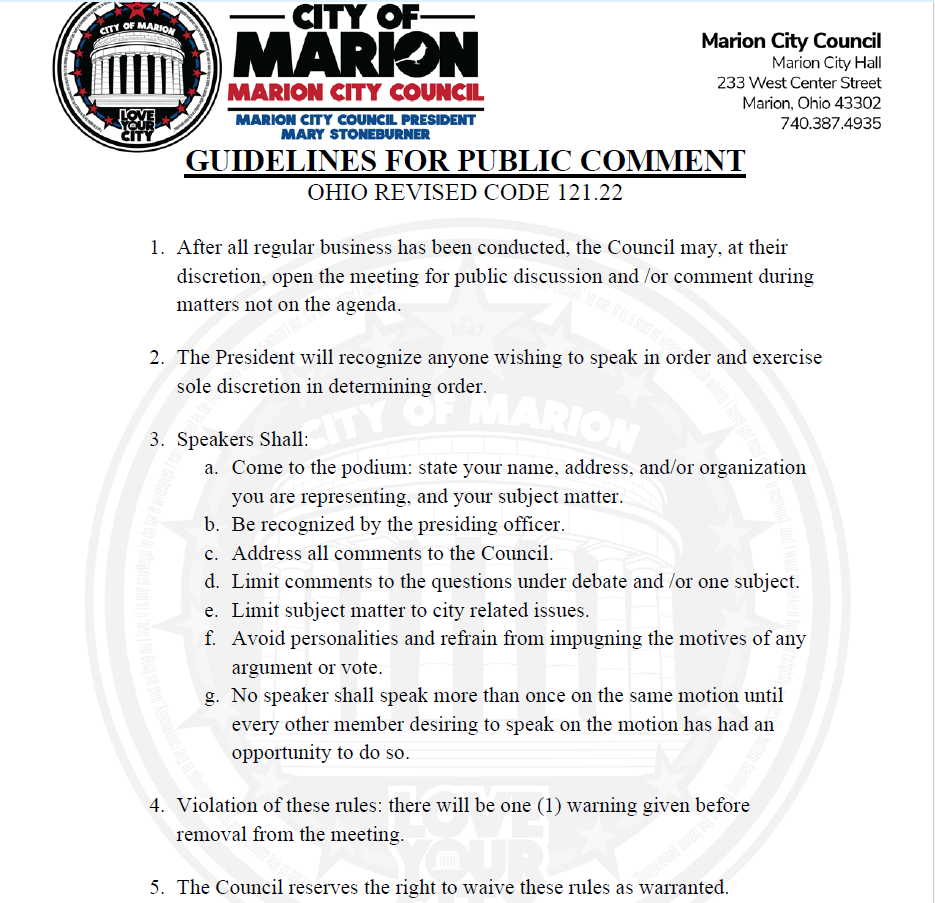
If Decorum Is the Problem, Why Don’t the New Rules Address the Audience?
By Ashton Seales
Marion Orwellian Watch
Marion City Council’s ongoing debate over meeting decorum took another turn at last Monday’s council meeting when Council Member Dan Clark explained why he believes the city’s rules need to be updated now.
According to Clark, the push to formalize and clarify council rules is being driven by increasing disruptions and unruly behavior from people attending meetings. His comments suggested that recent incidents involving audience members have highlighted the need for clearer procedures and stronger standards of conduct.
That explanation raises an obvious question:
If the concern is audience behavior, why do the proposed rule changes focus almost entirely on speakers at the podium rather than audience members sitting in attendance?
That question becomes even more relevant when examining the city's existing "Guidelines for Public Comment," which have already been in place for council meetings. The current guidelines require speakers to be recognized by the presiding officer, address their comments to council, limit remarks to city-related issues, avoid personal attacks, and comply with the directions of council leadership. The guidelines also state that a speaker will receive one warning before being removed from a meeting for violating the rules.
In other words, council already possesses a framework governing public participation.
What the proposed decorum revisions appear to do is take many of those existing expectations and place them into council's formal rules. Yet while the justification for the changes has centered on disruptive audience behavior, the language being debated primarily regulates individuals who come to the podium to speak.
That distinction became even more apparent during council's discussion of the proposed amendments.
Council Members Aaron Rollins and Thaddeus Smith both spoke on the motion and expressed reservations about moving forward with the changes in their current form. While neither argued against maintaining order during meetings, both questioned whether now is the appropriate time to implement new decorum rules and whether the proposed framework is the correct approach.
Their comments reflected a belief that Marion City Council does not necessarily suffer from a lack of rules, but rather from a failure to consistently enforce the rules that already exist.
That perspective highlights a key divide in the debate. Supporters of the amendments argue that codifying and clarifying expectations will remove ambiguity and create consistency moving forward. Critics, however, question whether creating additional language solves anything if existing policies and procedures are not being utilized when disruptions occur.
If the objective is to curb disruptive behavior in the audience, it remains unclear how placing additional restrictions and procedures on public-comment speakers accomplishes that goal. A resident who shouts from the gallery, disrupts proceedings from their seat, or refuses to follow instructions is not necessarily affected by many of the provisions directed at podium speakers.
Conversely, residents who voluntarily approach the podium to address their elected representatives are the people who would experience the most direct impact from the proposed changes.
This disconnect between the stated justification and the actual language being considered has become one of the central questions surrounding the decorum debate.
If unruly audience behavior is the catalyst for reform, many residents may reasonably ask why the proposal does not specifically address audience conduct. Likewise, if council already has the authority to warn, remove, and control disruptive participants—as evidenced by the existing public-comment guidelines and as suggested by Rollins and Smith—then the discussion shifts from whether new rules are necessary to whether current rules are being enforced.
Council leaders have argued that clearer rules provide consistency and eliminate uncertainty. Yet the discussion at Monday's meeting underscored that not all council members agree that creating new rules is the solution.
The existing public-comment guidelines already establish expectations for speakers and already provide a mechanism for removal after a warning. The question raised by opponents of the proposed changes is simple: if those rules are not being enforced today, what assurance exists that placing similar language into another section of council's rules will produce a different result tomorrow?
As council continues considering the proposal, residents may want a more direct explanation: Is the goal to address disruptive spectators, regulate public-comment speakers, or simply reinforce authority that council already possesses?
Because based on both the existing public-comment guidelines and the draft amendments under consideration, the proposed changes appear far more focused on those standing at the podium than on the audience behavior cited as the reason the revisions are needed in the first place.
Until that contradiction is resolved, questions about the necessity, timing, and purpose of the amendments are likely to remain at the center of the debate.
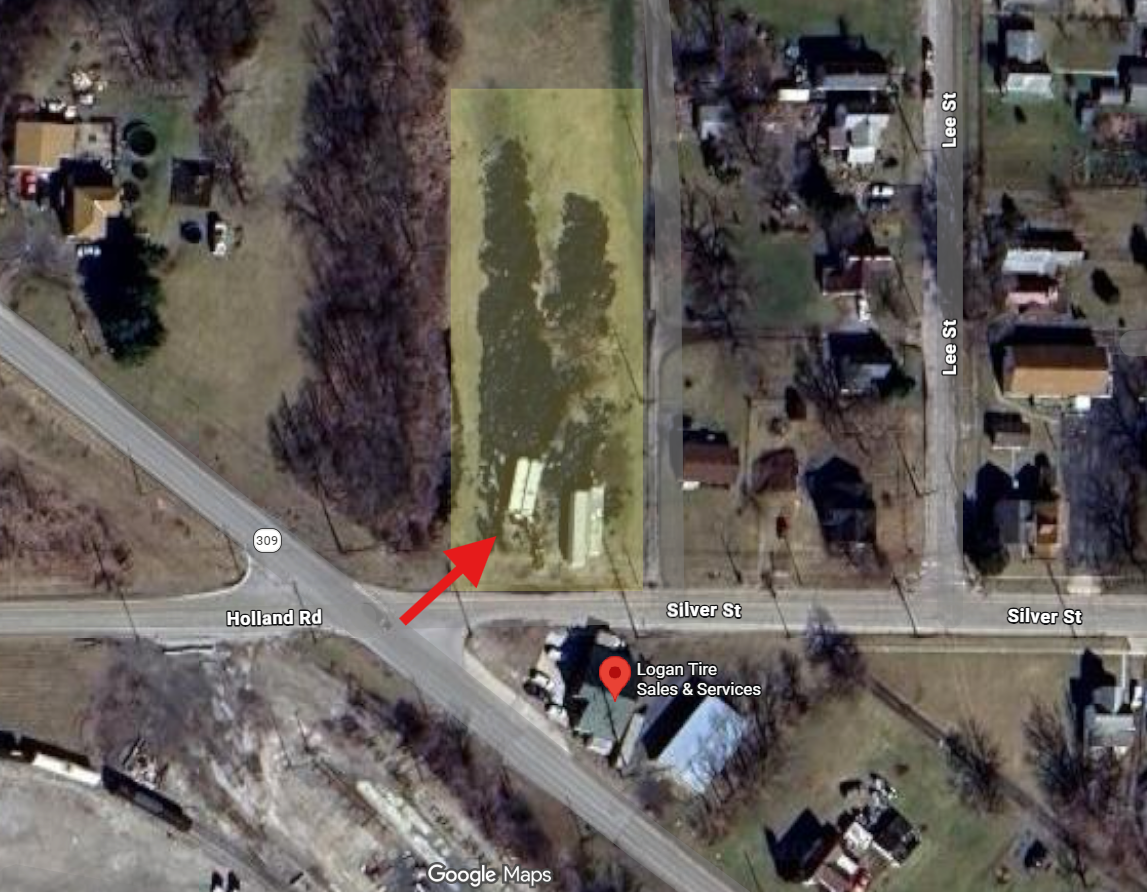
Silver Street Annexation Shows Need For Clearer Public Explanation
The “emergency” label appears tied to Ohio’s short annexation timeline, but residents were still left sorting through cleanup, zoning, probate, ownership, and development concerns.
By Michael Grubbs
Marion Orwellian Watch
Project: Silver Street annexation
The Silver Street annexation has already moved through the public process, but the records surrounding it show why some residents may have found the issue confusing.
At first glance, the word “emergency” in city legislation can sound like something is being rushed through before the public has time to understand it. In municipal language, however, an emergency measure can also mean that legislation needs to take effect quickly because of a legal timeline.
That appears to be the case with the Silver Street annexation.
The timing is important. Under Ohio’s special annexation procedure, once an annexation petition is filed, the municipal legislative authority has 20 days to adopt an ordinance or resolution stating what services it would provide to the territory if annexed. That does not mean council has 20 days to fully debate every related issue around the property. It means the city has a short statutory window to place its service commitment into the annexation record.
That 20-day clock may explain why the issue moved quickly once the petition entered the public process. It also helps explain why the word “emergency” appeared in the legislation. But without that explanation stated plainly, residents could easily read the word as a sign that officials were rushing the matter for reasons not visible in the agenda.
City agenda materials for March 23, 2026 listed a resolution for the proposed annexation of territory near Silver Street and East Euclid Avenue, containing 1.785 acres, and described it as “declaring an emergency.” The same agenda described the resolution as an agreement by the city to provide fire protection, zoning, police protection, street maintenance, and other ordinary city services to the territory proposed for annexation.
Later city agenda materials show Ordinance 2026-035, accepting the annexation of certain territory west of the City of Marion, also described the measure as “declaring an Emergency.”
It is also important to separate who initiated the annexation from how the city responded to it. Ohio annexation law provides for petitions signed by property owners, and the city’s March 23 agenda described the matter as a response to territory proposed for annexation. In other words, the annexation request was not presented as something the city itself initiated.
That wording may be normal government procedure. But it is also easy to misunderstand, especially when the property is connected to a former tire site, cleanup funding, estate or ownership concerns, zoning, and a proposed Dollar General development.
What The Public Saw
The March 23 agenda listed the annexation matter before a special Zoning and Annexation Committee meeting, followed by a regular City Council meeting that same evening.
The public-facing agenda identified the matter as a city-services resolution for annexation. It did not, on its face, explain every issue residents later raised around the property.
The April 27 City Council agenda then listed Ordinance 2026-035 as a new business item: “Ordinance Accepting the Annexation of Certain Territory Located South of the City of Marion Containing 1.785 Acres and Declaring an Emergency.” The agenda also noted the Zoning and Annexation Committee had sent the matter forward with a 3-0 “No Recommendation.”
By May 11, the ordinance appeared under old business as “Annexation Silver St. Amended,” again described as accepting the annexation of certain territory west of the City of Marion containing 1.785 acres and declaring an emergency. The May 11 agenda noted that the first reading had occurred on April 27.
For residents trying to follow the issue, that is a lot to process: annexation, emergency language, committee action, council readings, zoning, city services, and a proposed development all moving through formal documents.
What “Emergency” Appears To Mean Here
Based on the city records reviewed, the emergency language appears to be about timing under Ohio annexation procedure, not a sudden public danger at the property.
That distinction matters. If residents hear “emergency,” they may reasonably think there is an immediate health or safety crisis. But in this context, the more likely meaning is that council had to act within a required legal window and wanted the measure to take effect without delay.
That does not make the word meaningless. It makes plain-language explanation more important.
The city could have reduced confusion by making clear that the emergency language was tied to the annexation process, including the 20-day service-statement requirement, and not necessarily to an immediate condition at the site.
Public Records Requests Added Context
Marion Orwellian Watch also reviewed records received through public records requests submitted to Marion Public Health and the Marion City/County Regional Planning Commission.
Those records added context about the property’s cleanup and development timeline. Records received from those offices indicate that discussion of the property, cleanup status, and a possible Dollar General development began before the annexation appeared on the March 2026 council agenda.
The records also indicate that cleanup funding was connected to the Ohio Attorney General’s Shine a Light Grant program, rather than direct City of Marion funding.
The cleanup records also had a legal-enforcement backdrop. In correspondence received through the public records process, a Marion Public Health official stated that the Shine a Light Grant was aimed at previously identified properties that had been referred for prosecution but lacked the legal enforcement needed to achieve cleanup and health outcomes. In the Logan Tire matter specifically, the same correspondence described the cleanup problem as complicated by estate and probate issues. The official stated that Ohio EPA no-fault funds would not be available unless the estate was probated, and that legal action appeared unlikely because the owner of record was deceased.
A court docket screenshot reviewed by Marion Orwellian Watch identified an estate case for Kurtis Lee Logan, with Marcie Lynn Fisher-Logan listed as fiduciary, filed September 11, 2025, and marked open at the time of the screenshot. That does not, by itself, show anything improper about the cleanup or annexation. But it does help explain why probate, enforcement, and cleanup questions became tied together in the public record.
In correspondence received through the public records process, a Marion Public Health official stated that the property was added for Shine a Light Grant cleanup consideration only after checking with the Ohio Attorney General’s office and receiving approval to proceed. The official also stated that they would not have moved forward without that approval.
That same correspondence also stated that the official was unaware of the parcel annexation until seeing it on a City Council agenda. That is consistent with the annexation being initiated through a property-owner petition and then routed through the required public process.
Because those records were received through public records requests rather than pulled from a public web page, Marion Orwellian Watch is not listing private email names in this article. The relevant offices are identified so readers understand where the records came from.
Why Residents Wanted Clarity
Even if the emergency language was procedural, residents still had reason to want a clearer explanation.
The property was not just an empty piece of land being annexed in isolation. It was connected to a former tire-related property, cleanup activity, possible environmental concerns, probate or ownership issues, and a proposed Dollar General development.
Public concern about those issues should not be dismissed as confusion or opposition for its own sake. The process involved multiple moving parts, and the public-facing language did not always make those parts easy to separate.
The most important distinction is this: the available records do not show that “emergency” meant there was an immediate documented danger at the property. They point instead to a time-sensitive legal process.
But that does not erase the transparency problem. If a government process is legally time-sensitive, officials should explain that clearly, especially when the issue affects a neighborhood and involves prior cleanup concerns.
The Larger Takeaway
The Silver Street annexation is a reminder that government language can shape public trust.
A legally routine phrase may sound alarming to residents. A time-sensitive process may look like a rushed process. A state-funded cleanup may draw public concern when the same property is later connected to private development.
None of that proves wrongdoing. But it does show why clear public explanation matters.
The fair conclusion from the records reviewed is this: the Silver Street annexation appears to have used emergency language because of legal timing, not because of an immediate documented property emergency. At the same time, residents were left trying to understand a complicated overlap of cleanup, annexation, zoning, probate, ownership, and development issues.
That is where the public accountability issue remains.
References:
City of Marion Agenda Center: https://www.marionohio.us/AgendaCenter
Ohio Revised Code Section 709.023, special annexation procedure where land is not excluded from township: https://codes.ohio.gov/ohio-revised-code/section-709.023
Marion City Council and Special Zoning and Annexation Committee agenda, March 23, 2026: https://www.marionohio.us/AgendaCenter/ViewFile/Agenda/_03232026-286
Marion City Council agenda, April 27, 2026: https://www.marionohio.us/AgendaCenter/ViewFile/Agenda/_04272026-291
Marion City Council agenda, May 11, 2026: https://www.marionohio.us/AgendaCenter/ViewFile/Agenda/_05112026-294
City of Marion Forms page, noting zoning or alley/street vacation applications go before the Planning Commission before being heard by Council: https://www.marionohio.us/175/Forms
Additional records were reviewed from public records requests submitted to Marion Public Health and the Marion City/County Regional Planning Commission.

Marion to End Curbside Recycling While Raising Sanitation Rates
By Ashton Seales
Marion residents received more clarity Monday night about the future of the city's recycling program; and for many households, the news may feel like paying more for less.
During the May 18 committee meetings of Marion City Council, Mayor Bill Collins announced that the city will discontinue curbside recycling effective July 1, replacing it with a self-service drop-off program at the city garage.
The announcement comes just weeks after city officials approved a sanitation rate increase that raises residential sanitation bills from $22 to $25 per month, an increase of 13.65%, projected to generate approximately $250,000 annually in additional revenue.
For many residents, the timing raises an obvious question: Why are sanitation rates increasing while a service residents have relied on for years is being eliminated?
Mayor: Survey Results Were Split
Addressing the issue Monday night, Collins said the city had been gathering public feedback through a survey and found opinions divided.
"The survey has stayed about 50-50. Some people want it for free down at the city garage. Other people say they would pay the five dollars extra," Collins said.
Despite those responses, the administration decided to move forward with ending curbside collection.
According to Collins, the city spends nearly $500,000 annually on the recycling program, and changing market conditions have transformed recycling from a revenue source into an expense.
"We used to get paid to take our stuff to somebody to recycle. Now we pay them to take our stuff to recycle," Collins explained.
Beginning in July, residents wishing to recycle will need to transport materials themselves to a designated drop-off site at the city garage. Current plans call for the facility to operate from 11 a.m. to 7 p.m. daily, with discussions continuing regarding Saturday availability.
The mayor stated that no city employees are expected to lose their jobs as a result of the change, as vacant positions in sanitation and the streets department will absorb affected workers.
Paying More, Receiving Less
The city's explanation focuses on cost savings, but many residents are likely to focus on a different reality: they are being asked to pay higher sanitation bills while losing a service that was previously included.
For years, curbside recycling offered convenience and accessibility. Residents simply placed recyclables at the curb alongside their regular trash collection. Under the new system, that responsibility shifts entirely to residents, who must now spend their own time, fuel, and effort transporting recyclables across town.
The city argues the drop-off center will remain free to use. However, "free" can be a relative term when residents must provide the transportation, dedicate personal time, and potentially make multiple trips throughout the year.
For senior citizens, individuals with disabilities, families with limited transportation, and residents working multiple jobs, the change may effectively reduce access to recycling altogether.
A Decision That Impacts Every Household
Unlike many city issues that affect only specific neighborhoods or groups, sanitation services touch virtually every household in Marion.
Every resident pays the sanitation bill. Every resident generates waste. Every resident will feel the effects of the policy change - whether through higher monthly costs, reduced convenience, or both.
That reality has led some residents to question whether the decision should have been made administratively after a survey or placed before voters for direct approval.
The survey itself, according to Collins, showed no overwhelming public consensus. With results reportedly remaining near a 50-50 split, critics may argue that such a significant change to a citywide service should have been decided by those who fund it: the taxpayers.
Residents are not merely customers of city services - they are the people paying for them. When a service is removed while rates simultaneously increase, many believe the public should have more than an advisory survey. They should have a vote.
A survey measures opinions. A vote determines policy.
Looking Ahead
City officials say details about the transition will be released before curbside recycling ends at the close of June. Information regarding accepted materials, operating procedures, and final hours of operation for the drop-off center is expected in the coming weeks.
The discussion Monday night also included continued conversations regarding council and citizen decorum during meetings, as well as preliminary discussions about regulations governing e-bikes, scooters, and other small vehicles.
The next meeting of Marion City Council will be held Tuesday, May 26, at 6:30 p.m. in the courtroom on the second floor of Marion City Hall. The next committee meetings are scheduled for Monday, June 1, at 6:30 p.m. in the same location.
As Marion moves forward with its plan, residents will soon have to decide whether recycling remains important enough to justify the extra trip, and whether paying higher sanitation rates while losing curbside service represents fiscal responsibility or a step backward for the community.
References
City of Marion, Ohio. Recycling Program. Retrieved May 21, 2026, from City of Marion Recycling Program. Information on the city's curbside recycling program, recycling benefits, collection procedures, and resident participation requirements.
City of Marion, Ohio. City of Marion Recycling Flyer. Retrieved May 21, 2026, from City of Marion Recycling Flyer (PDF). Official guide outlining accepted and prohibited recyclable materials, collection procedures, and program rules.
WWGH Radio. WWGH Talk – Marion, Ohio (Facebook Page). Retrieved May 21, 2026, from WWGH Radio Facebook Page. Source of public discussion and coverage regarding Marion city government, sanitation services, and recycling-related announcements.
Marion City Council. Regular Meeting Agenda, May 11, 2026. Retrieved May 21, 2026, from Marion City Council Agenda (May 11, 2026). Official agenda identifying the May 18, 2026 committee meetings and listing “Transit Rate Increase” among scheduled committee discussions.
City of Marion, Ohio. News Flash Announcement. Retrieved May 21, 2026, from City of Marion News Flash. Municipal announcement providing information related to city services and public notifications.
City of Marion, Ohio. Sanitation Rate Calculation: Increase Effective with May 2026 Billing Cycle (Bill Due June 2026). Retrieved May 21, 2026, from Sanitation Rates Calculation Document (PDF). Official rate schedule showing the increase in residential sanitation rates from $22.00 to $25.00 per month and estimating approximately $250,000 in additional annual revenue.
Additional Sources Cited
City of Marion, Ohio. Sanitation, Streets, Recycling & Central Garage Department Information. Retrieved May 21, 2026, from Sanitation/Streets Department. Department overview describing sanitation and recycling services provided to Marion residents.
Remarks of Mayor Bill Collins. Statements made during the Marion City Council Committee Meetings, May 18, 2026, regarding the planned discontinuation of curbside recycling effective July 1, 2026, creation of a city garage drop-off recycling center, projected cost savings, and employee reassignment plans. Video recording available through Marion City Council meeting archives and local media coverage.
Marion Transit Rate Hike Raises Questions
Service gaps were identified before the rate increase discussion moved forward.
By Michael Grubbs
Marion residents who depend on public transportation may want to keep a close eye on what happens next with Marion Area Transit.
At the May 27, 2025 Marion City Council meeting, consultants from Nelson Nygaard presented council with the results of a transit survey paid for by the Ohio Department of Transportation. According to the official council summary of proceedings, the presentation covered Marion Area Transit service, rider needs, possible expansions, and recommendations for future changes.
The study identified gaps in service and recommended several possible improvements, including longer service hours, Saturday service, more destinations, countywide expansion, marketing, employer outreach, technology improvements, partnerships, and fare increases.
But the clearest follow-up found in the public record so far was not a specific plan to add Saturday service, expand hours, or address early morning and late-night workforce transportation gaps. It was a May 18, 2026 committee discussion listed under Municipal Services, Parks & Recreation as “Transit Rate Increase.”
That does not mean council has already voted to raise fares. Based on the project materials reviewed for this draft, including the research tracker, official May 27, 2025 council minutes, and the May 11, 2026 council agenda listing May 18 committee business, the record shows a consultant recommendation and a later public discussion about increasing rates. It does not yet show final council action adopting a fare increase.
What Was Presented
The May 27 council minutes say Betthany Whittiker and Marvin Ronaldson of Nelson Nygaard presented a survey about Marion Area Transit. The minutes identify three types of service: On Demand, Night Moves Bus Route, and Dial a Ride Scheduling.
The presentation reportedly found that Marion’s transit service was performing well overall, but that the system has gaps. The minutes say the consultants discussed problems with driver retention, traffic patterns around downtown, the hospital, and the Mt. Vernon Avenue area, and service gaps for workers on second shift, third shift, and early first shift.
The recommendations included longer service hours, Saturday service, more destinations, possible countywide expansion, marketing, employer outreach, technology improvements, partnerships, and fare increases.
The cost estimates were also significant. The minutes state that early start and late stop service would cost about $120,000, while Saturday service would cost around $300,000. The presentation also said roughly half of some added expense could come from grants and fares, and an ODOT representative said some projects could involve an 80/20 split where ODOT and the federal government cover 80 percent and the city covers about 20 percent.
Current Fares
The City of Marion’s current bus fare page lists Demand Service within city limits at $1.25 for adults, $0.60 for disabled riders, seniors 65 and older, and students, and free rides for children 5 and under.
The city’s fare page also lists Enhanced Service inside city limits at $2.50 for adults and $1.25 for disabled riders, seniors, and students. Enhanced service two miles from transit is listed at $3.75 for adults and $1.85 for reduced-fare riders. Enhanced service five miles from transit is listed at $6.25 for adults and $3.10 for reduced-fare riders. Monthly passes are listed at $30 for adults and $15 for disabled riders, seniors, and students.
Those same fare amounts appear in the city’s September 6, 2024 transit brochure.
The Accountability Question
The policy question is simple: before Marion asks transit riders to pay more, which service gaps will actually be fixed, when, and at what cost?
Transit fare increases often sound small when presented line by line. But for riders who use the service regularly, especially seniors, disabled riders, students, workers without reliable cars, and low-income residents, even a modest increase can become a recurring burden.
The May 27 minutes include a key exchange on that point. Council member Mr. Ratliff said he strongly believed the city should not raise rates. The consultant responded that she understood because it was a policy decision.
That sentence matters. A fare increase is not just an accounting move. It is a political choice.
The public record shows the rate increase discussion moved forward. What remains unclear is whether the service improvements identified in the same study moved forward with the same urgency.
What We Still Need To Know
The records reviewed for this article leave several open questions:
Did Nelson Nygaard issue the written report the minutes said would be released in June?
What exact fare increases were recommended?
Has council, a committee, or the transit department taken any later action on fares?
Would any fare increase apply to Demand Service, Enhanced Service, Night Moves, monthly passes, or all categories?
Were the identified service gaps addressed before rates were increased or formally considered?
Did the city add Saturday service, earlier service, later service, employer-focused service, or more destinations after the survey?
How many riders would be affected, and how many are seniors, disabled riders, students, or workers using transit for employment?
What portion of Marion Area Transit operating costs currently comes from fares, grants, city funds, and other sources?
Was the public given clear notice before any fare-related decision moved forward?
Until those questions are answered, residents should treat the May 27 discussion as an early warning sign rather than a completed rate change.
Why This Matters
Marion Area Transit is not a luxury service. The city itself describes MAT as public transportation open to the general public and funded in part by ODOT and the Federal Transit Administration. The May 27 presentation framed transit as a workforce issue, noting that reliable transportation helps people get to jobs and helps employers reach workers.
That makes the fare discussion especially important. If the city says transit helps people get to work, then fare policy should not quietly make that same service harder to use while the workforce-related service gaps remain unresolved.
Marion Orwellian Watch will continue tracking whether this recommendation turns into legislation, administrative action, or a budget decision.
For now, the public record shows this: consultants identified service gaps and recommended several changes, including fare increases; at least one council member objected to raising rates; and the May 18, 2026 committee schedule later placed “Transit Rate Increase” before Municipal Services, Parks & Recreation. What the available records do not yet show is whether Marion addressed the service gaps before moving the rate discussion forward.
References:
Marion City Council, “Summary of Proceedings,” May 27, 2025, official minutes: https://www.marionohio.us/AgendaCenter/ViewFile/Minutes/_05272025-163
Marion City Council, regular meeting agenda, May 11, 2026, committee schedule listing May 18, 2026 “Transit Rate Increase”: https://www.marionohio.us/AgendaCenter/ViewFile/Agenda/_05112026-294
City of Marion, “Bus Fares”: https://www.marionohio.us/203/Bus-Fares
City of Marion, “Bus / Transit”: https://www.marionohio.us/200/Bus-Transit
City of Marion, Marion Transit brochure updated September 6, 2024: https://www.marionohio.us/DocumentCenter/View/8930/Brochure-Template-Transit-Flier-9-6-24
Project tracker reviewed: Marion_City_Council_Research_Tracker_v5_ID_Automation_Setup.xlsm, Meetings tab, MTG-003 and Sources Archive, SRC-011
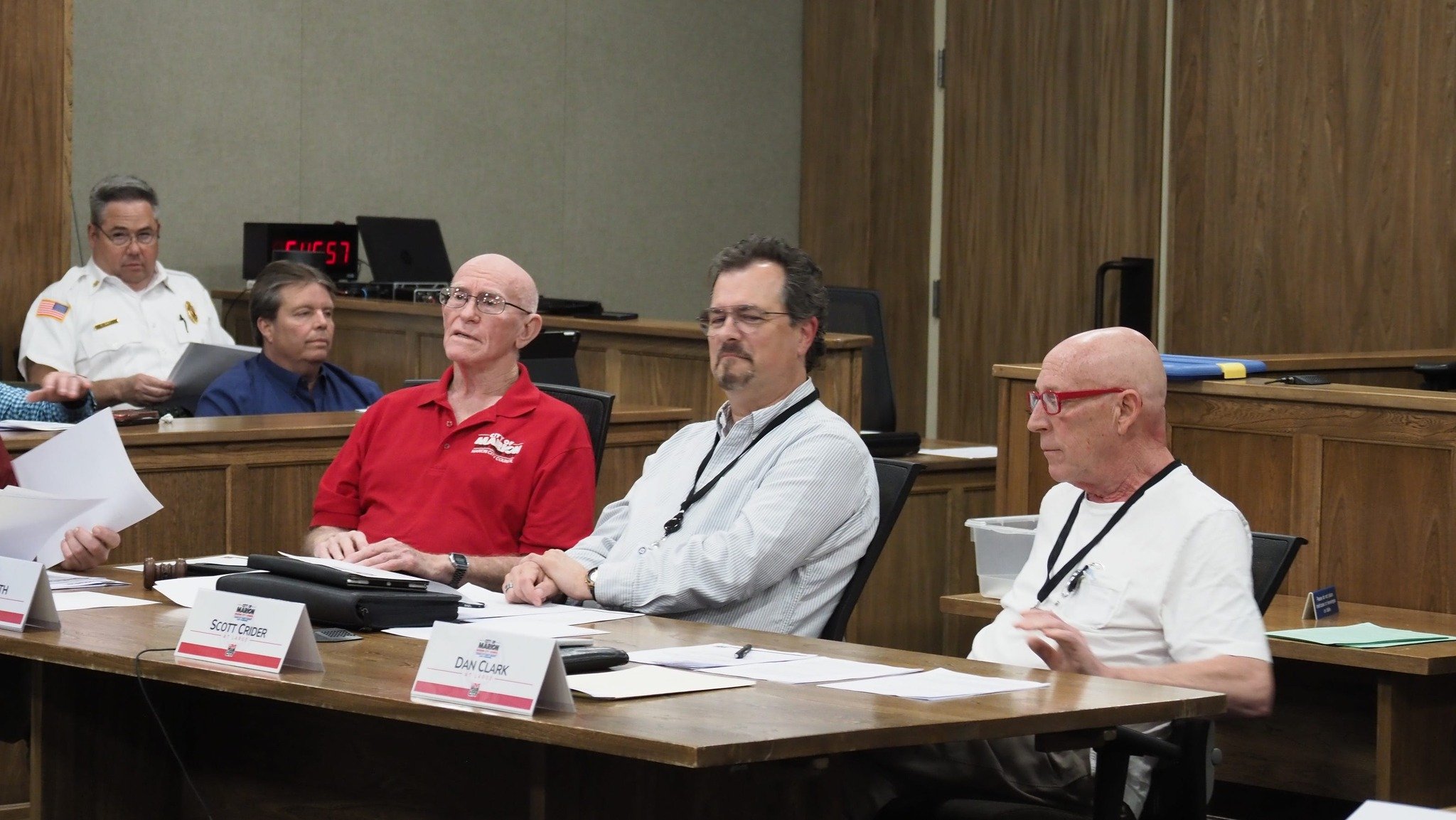
Marion City Council Decorum Meeting
Residents and council members in Marion are expected to gather tonight as proposed changes to council decorum rules take center stage during a closely watched city council meeting scheduled for 6:30 p.m.
According to meeting agendas and committee documents released ahead of the session, council members are scheduled to discuss amendments related to conduct during meetings, including potential updates to rules governing public participation and member behavior during debate.
The proposed changes follow recent discussions among city leaders regarding how meetings are conducted and how disruptions, public comments, and council interactions should be handled moving forward. The issue has generated growing interest among residents who view public comment periods as one of the few direct opportunities to address elected officials in an open forum.
Supporters of the rule changes argue the amendments are intended to maintain order, improve efficiency, and ensure meetings remain productive. Some officials have expressed concerns over interruptions, prolonged exchanges, and increasingly tense interactions during recent council sessions.
Opponents, however, say stricter decorum policies could discourage public participation and limit residents’ ability to voice concerns about pending legislation and city decisions. Several community members are expected to speak during public comment, with some arguing that transparency and accountability depend on allowing citizens broad opportunities to address council members directly.
The discussion stems in part from legislation introduced through the city’s Legislation, Codes, and Regulations Committee, which includes proposed amendments to council rules concerning duties, privileges, and decorum of members.
Tonight’s meeting is anticipated to draw heightened public attention as residents, council members, and city officials debate where the balance should lie between maintaining order and preserving open public dialogue.
The meeting is open to the public and is expected to include both committee discussion and citizen comment before any potential action is taken on the proposed rule changes.

4th Ward Has a New Council Member
Last night’s Marion City Council meeting, expected to bring closure to the ongoing controversy surrounding the Fourth Ward vacancy, instead left many residents with even more questions about transparency, process, and political priorities inside Marion City Hall.
In a surprising move at the start of the meeting, City Council voted to shift the Fourth Ward appointment from the final item on the evening’s agenda to the very first item discussed. The sudden change reportedly came without public notice, catching some Fourth Ward residents off guard and preventing several individuals who planned to attend specifically for the appointment discussion from being present when the vote occurred.
The abrupt scheduling change immediately drew criticism from residents in attendance, several of whom voiced concerns about both the lack of transparency and the handling of the appointment process overall.
Debate during the meeting once again centered heavily on political party affiliation - the same issue that has dominated discussion since Shawn Wilson’s earlier appointment and resignation.
Council member Ralph Smith continued insisting during discussion that the Fourth Ward seat was legally required to be filled by a Republican candidate. However, Council member Scott Crider repeatedly pushed back on that claim, explaining during the meeting that the Marion County Board of Elections had already clarified Wilson was officially listed as “unaffiliated” at the time of his appointment.
That distinction has become a central point of controversy in recent weeks.
Public records and correspondence previously reviewed by residents showed the Board of Elections specifically stated Wilson remained unaffiliated in the voter registration system despite having recently pulled a Republican primary ballot. The Board also previously indicated City Council had not consulted election officials before Wilson’s original appointment.
Several residents who addressed council Monday night referenced those same facts, arguing that continuing to describe the seat as strictly Republican contradicted the Board of Elections’ own statements.
Others questioned why council leadership would unexpectedly move the appointment vote to the beginning of the meeting when the item had previously been expected to occur at the end of the agenda.
Despite those objections, council ultimately moved forward with the appointment process anyway, leaving some residents frustrated that political considerations appeared to outweigh broader concerns about transparency, public participation, and trust in local government. They appointed 29 year old Nathan Stevenson, a Marion native.
For many watching the meeting unfold, the evening reinforced a growing perception that party loyalty carried more influence than public input.
In addition to the controversy surrounding the Fourth Ward appointment, council members also discussed a proposed annexation involving property across from Logan Tires, where a Dollar General development has reportedly been proposed.
That discussion sparked significant public comment from residents living on that side of Marion, many of whom described ongoing struggles accessing basic grocery and food options due to the railroad crossings that frequently isolate portions of the city from one another when trains block the tracks - a longstanding and widely recognized issue in Marion.
Several residents spoke passionately about the need for accessible food options in the area, arguing that many families are effectively cut off from the rest of town for extended periods when trains are stopped across crossings.
At the same time, other residents expressed concern specifically about Dollar General as the proposed solution.
Speakers noted that while most people appear to agree some form of food access is desperately needed for residents on that side of town, Dollar General has faced repeated criticism nationwide and within Ohio over alleged pricing and consumer practices that disproportionately impact lower-income communities.
Residents referenced the company’s history of lawsuits and investigations related to allegations that items advertised or displayed at one price were scanned at higher prices at the register - concerns critics describe as especially harmful for families already struggling financially.
Others questioned whether a discount retailer known primarily for shelf-stable and processed goods truly addresses the broader issue of healthy and reliable food access in underserved neighborhoods.
Additional concerns were also raised about the condition of the proposed annexation property itself.
Residents questioned whether years of accumulated tire waste and industrial use at the nearby site may have contaminated the land, and some warned that if environmental cleanup issues are later discovered, Dollar General could ultimately walk away from the project entirely - potentially leaving Marion taxpayers responsible for remediation costs.
While opinions differed on the proposed development itself, many residents appeared united in one belief: the area desperately needs investment and improved food access, but citizens want to ensure any solution genuinely benefits the community rather than creating new long-term problems.
After weeks of controversy surrounding appointments, resignations, eligibility questions, and public criticism over transparency, Monday night’s developments are unlikely to quiet concerns surrounding how Marion City Council handled one of the city’s most closely watched vacancy appointments in recent memory.
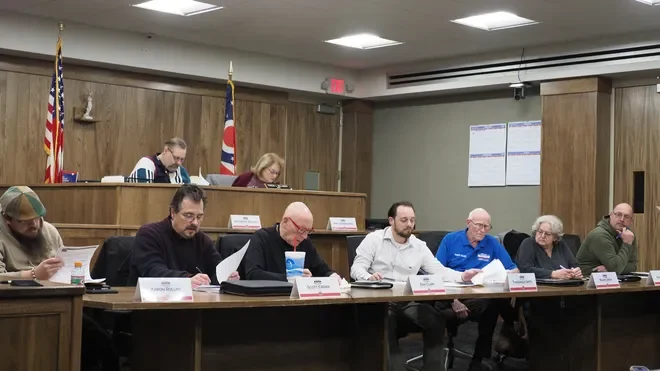
Eyes on City Council
Tonight’s Marion City Council meeting could mark the conclusion of one of the most closely scrutinized appointment processes in recent city history, as council members are expected to select a new representative for the Fourth Ward seat during the 6:30 p.m. meeting at City Hall.
The vacancy process began earlier this spring following the departure of the ward’s previous council representative. In April, City Council voted to appoint Shawn Wilson to the seat, describing him during public meetings as a Republican candidate qualified to fill the vacancy. However, questions surrounding Wilson’s eligibility emerged almost immediately after the appointment.
Public concerns centered on two primary issues: Wilson’s employment with the Ohio Department of Transportation (ODOT) and his voter registration status. Residents raised questions about whether a classified ODOT employee could legally serve in partisan elected office under Ohio Revised Code 124.57, which limits political activity for classified state employees. Additional scrutiny followed after publicly available voter records appeared to list Wilson as an unaffiliated voter rather than a Republican.
Emails exchanged between residents, City Council leadership, the Marion County Board of Elections, and the City Law Director revealed growing confusion over how the appointment had been handled and whether council had properly verified Wilson’s qualifications before the vote. In correspondence responding to public inquiries, Marion City Council President Mary Stoneburner confirmed that Wilson ultimately resigned after discussions involving ODOT and legal concerns related to his employment status.
At the same time, debate intensified regarding party affiliation requirements for the Fourth Ward vacancy. During council meetings, members stated the seat was required to remain Republican because the previous officeholder was a Republican. But the Marion County Board of Elections later clarified that Wilson was still officially listed in the voter registration system as “unaffiliated” at the time of his appointment, despite having recently pulled a Republican primary ballot.
The Board of Elections also stated publicly that Marion City Council had not consulted the board prior to the appointment, contradicting statements made during council discussions suggesting election officials had been involved.
As criticism mounted, residents called for greater transparency, accountability, and clarification regarding the legal process used to fill the vacancy. Questions were also raised about whether political connections may have influenced the original appointment process. City Law Director Mark Russell later confirmed that council retains authority under Ohio law and council rules to fill the vacancy through a roll call vote of sitting council members, while encouraging qualified Fourth Ward residents to express interest in serving.
Now, weeks after the resignation that reignited debate over transparency and procedure inside Marion City Hall, council is once again expected to cast votes tonight to determine who will represent Fourth Ward residents moving forward.
At this point, the only name that has been publicly and actively mentioned as pursuing the appointment is community advocate Krista Halloran, whose supporters describe her as a thoughtful and well-rounded candidate focused on transparency, communication, and public trust.
As residents prepare to attend tonight’s meeting, many will be watching closely to see whether City Council can restore confidence in the process - and whether council members will ultimately select the candidate that is best prepared to represent the people of Marion’s Fourth Ward.